StarsPeer-reviewed: Nature
Telescopes watched a small star spiral into a giant star in Andromeda
A study in Nature follows the pair, nicknamed Bao, from years of slow brightening to a bright eruption in 2025. The team concludes the stars merged, while another team's model says the smaller star may have survived.
The short version
- In the Andromeda galaxy, a small star spiraled into a giant star about 7 times the Sun's mass. The Nature team puts the small star at about 0.7 times the Sun's mass, and telescopes followed the pair for years.
- The team concludes the small star reached the giant's core about seven orbits, roughly seven years, after the two first touched.
- Another team's paper, accepted by The Astrophysical Journal Letters, models a heavier companion that was still orbiting at least 400 days later, so the outcome is still debated.
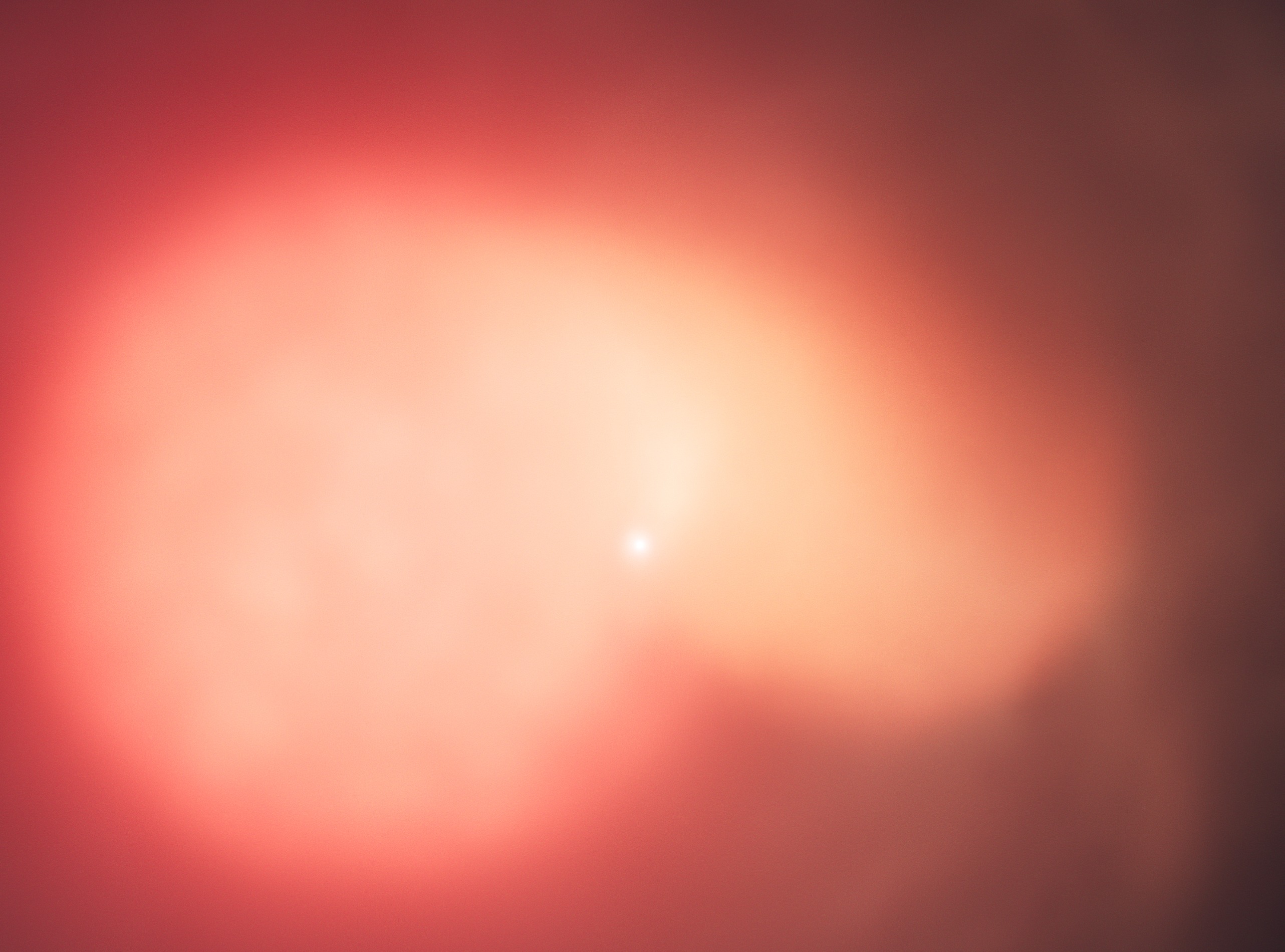
In the Andromeda galaxy, about 2.5 million light-years away, a star the team estimates at about 0.7 times the Sun's mass spiraled into a giant star about 7 times the Sun's mass. A study in Nature followed the pair, formally AT 2025abao and nicknamed Bao (the two stars are called Big Bao and Little Bao), from the slow start of that inspiral to a bright eruption in 2025. The team concludes that the small star merged with the giant's core, about seven orbits after the two first touched.
The study was led by Viraj Karambelkar, a NASA Hubble Fellow at Columbia University. Co-authors include Kishalay De of Columbia and Nadia Blagorodnova of the University of Barcelona, and Karel Temmink of Radboud University led the simulations. It is published in Nature.
A stage astronomers had only theorized
In this stage, called common envelope evolution, two stars orbit inside one shared outer layer, and drag inside it makes the smaller star spiral inward. Astronomers think this shared-envelope stage is how the tightest star pairs form. The paper says such an inspiral had never been observed directly.
Merging is not the only way a shared envelope can end. In other systems both stars survive in a tight orbit, and the stars in such pairs can later become neutron stars or black holes, explode as supernovae, or end as pairs that send out gravitational waves.
Years of slow brightening, then an eruption
Before 2018 the system's brightness had been steady. The team first noticed it in February 2023, as an unusual variable star in data from NASA's NEOWISE space telescope. The team explains its slow brightening as the small star spiraling through the giant's outer layers for about seven years.
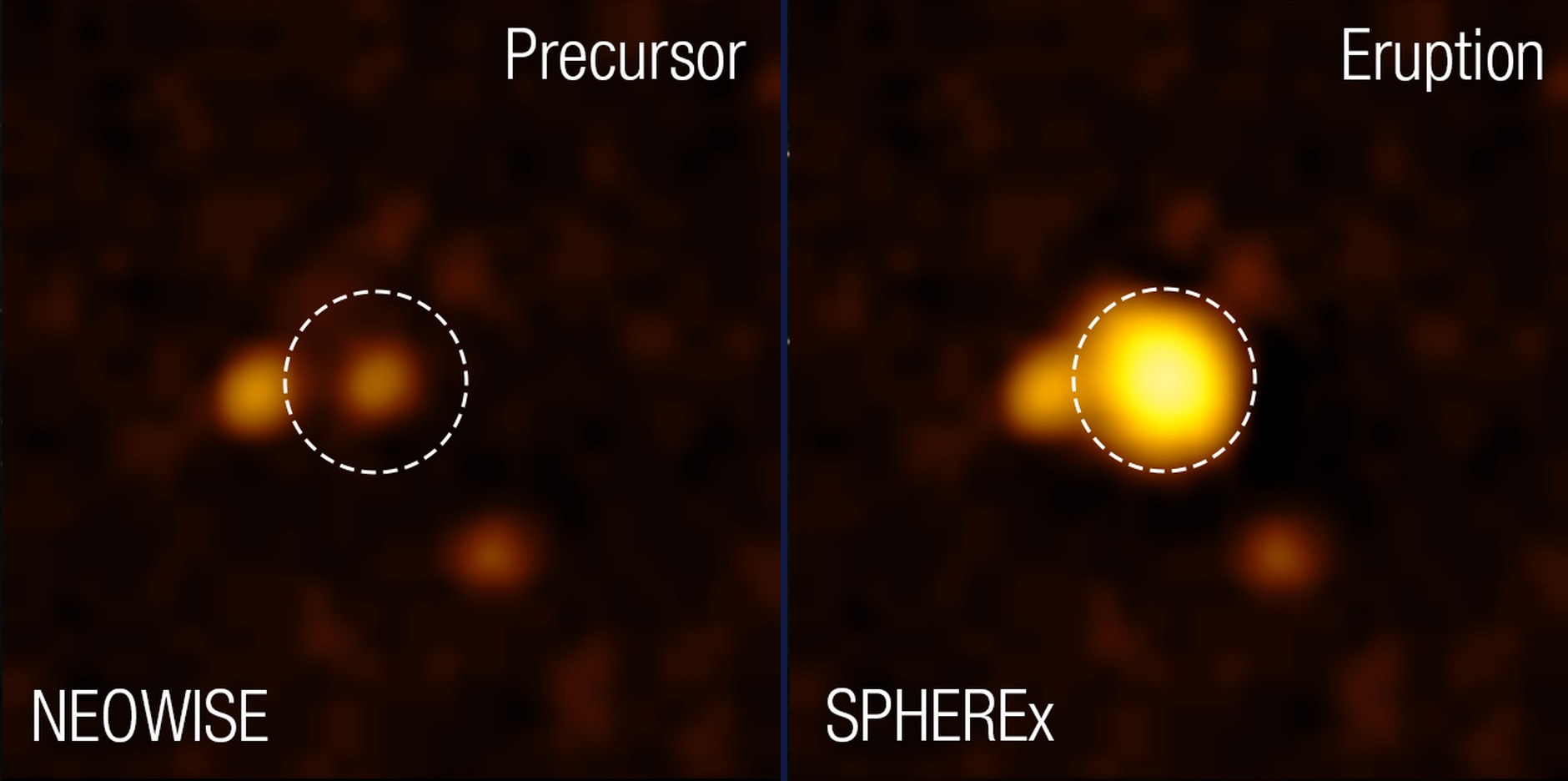
In July 2025, months before the eruption, NASA's SPHEREx space telescope saw the system brighten in infrared light during a routine survey. The Zwicky Transient Facility, a sky survey, detected the eruption on Oct. 17, 2025. The James Webb Space Telescope observed the system on Dec. 24, 2025, 47 days after the eruption peaked. The eruption threw off about 0.1 to 0.2 times the Sun's mass of material.
From modeling, the team estimates the giant at about 7 times the Sun's mass and 350 times its radius, and about 18,000 times brighter than the Sun. The modeling also gave an estimate for the companion's mass, about 0.7 times the Sun's. The team's model first suggested the small star might have had enough energy to escape. Further analysis led the team to conclude it was dragged into the giant's core.
By the team's account, the years of slow brightening were the inspiral itself: once the small star touched the giant, it took about seven orbits, about seven years, to reach the core.
Another team's model has the small star surviving
Nature's press summary says "future observations will be needed to confirm conclusively that the two stars merged." Another team's paper, accepted by The Astrophysical Journal Letters, models the same event with a heavier companion that was still orbiting the giant's core at least 400 days into the shared-envelope phase, so the outcome is still debated.
That rival model puts the companion at about 1.4 times the Sun's mass, with an uncertainty of plus 0.2 or minus 0.3, and the giant at about 6.9 times the Sun's mass. That team also reads the years of slow brightening differently: as the companion moving through the giant's wind, the gas blowing off it, before the two shared an envelope, rather than spiraling inside the giant itself. Its authors write that Bao may be the first shared-envelope event caught forming a close pair rather than a merger.
Bao's eruption belongs to a known class called luminous red novae, which astronomers link to pairs of stars sharing an envelope, and it is the fourth found in Andromeda. At its peak it reached magnitude 15.1 in green light, the g band. The faintest stars the naked eye can see on the darkest nights are about magnitude 6.5, so at its peak the eruption was about 2,800 times too faint to see without a telescope. The Andromeda galaxy itself, though, can be seen with the naked eye on moonless nights, even from places with moderate light pollution.
What comes next
Bao gives astronomers their first chance to follow this shared-envelope stage as it happens, from steady light, through years of slow brightening, to the eruption. Karambelkar says the team wants to find more such systems, and expects the Vera C. Rubin Observatory and the Nancy Grace Roman Space Telescope to find them.
By the numbers
- The giant's mass
- About 7 times the Sun's the team's estimate before the eruption [1]
- The giant's radius
- About 350 times the Sun's [2]
- The companion's mass
- About 0.7 times the Sun's the Nature team's estimate [1]
- Orbits from first contact to merger
- About 7 about seven years, by the Nature team's account [2]
- Webb's first look
- 47 days after the peak Dec. 24, 2025 [2]
- Material thrown off
- 0.1 to 0.2 times the Sun's mass [5]
Explore it on CycleCalcs
Sources
- Primary source V. Karambelkar et al., "An inspiral of a star inside a common envelope with its giant companion," Nature (2026), doi:10.1038/s41586-026-11221-z
- Background NASA press release, "NASA Data Clinches First-of-Its-Kind Stellar Merger," Nov. 18, 2026
- Independent report ABC News (Australia), headline beginning "First time giant star 'caught in the act'," by Jacinta Bowler, Nov. 19, 2026
- Background Springer Nature press release, via Nanowerk, "Astronomers witness a giant star engulfing its companion in Andromeda"
- Independent report Sci.News, "Webb Catches Giant Star Swallowing Its Smaller Companion in Andromeda Galaxy"
- Data Z. Chen et al., "Unravelling the Nature of AT 2025abao: From Precursor to Final Fate," arXiv:2610.05769v2, accepted by The Astrophysical Journal Letters
- Data A. Reguitti et al., "AT 2025abao: The fourth luminous red nova in M 31," Astronomy & Astrophysics 709, A25 (2026), arXiv:2602.13678
- Data NASA Goddard (NSSDCA), Planetary Fact Sheet
- Background Wikipedia, Andromeda Galaxy (distance)
- Background Wikipedia, Apparent magnitude (naked-eye limit and the magnitude scale)
Images: Illustration: NASA, ESA, CSA, STScI, Leah Hustak (STScI); Science: Viraj Karambelkar (Columbia) (public domain, U.S. government work); Image: NASA, ESA, CSA, STScI, Viraj Karambelkar (Columbia), Kishalay De (Columbia); Image Processing: Alyssa Pagan (STScI); Acknowledgment: DSS, Robert Gendler (public domain, U.S. government work).