ExoplanetsPeer-reviewed: Nature
New method shows the known planet 51 Eridani b at 4.3 microns
The method, called FLIP, adds a model of the telescope's own optics to the reference stars the standard technique relies on. On the Webb data tested, it was 2 to 15 times more sensitive.
The short version
- A new image-processing method, FLIP, found the known giant planet 51 Eridani b in a Webb image at 4.3 microns, the first image of the planet at that wavelength.
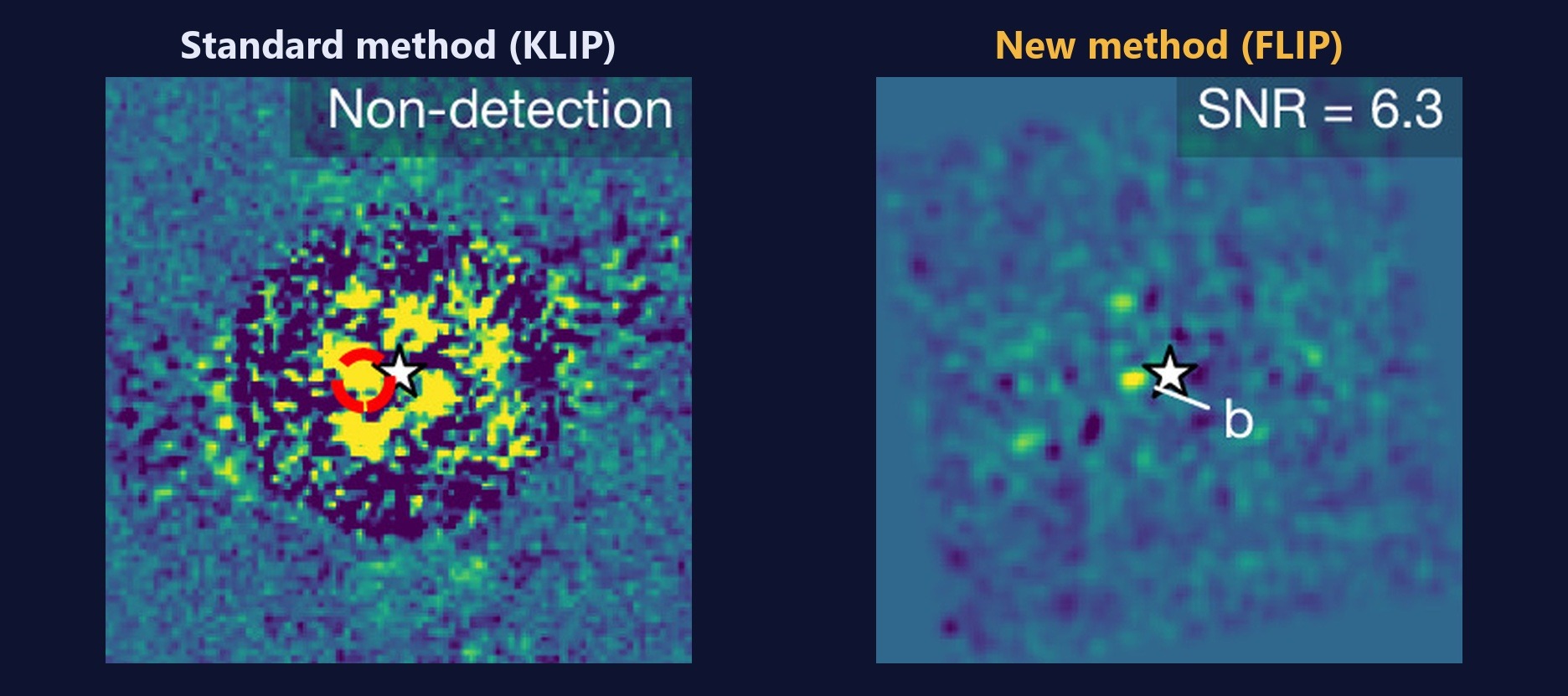
- The standard method had not detected the planet in that image; FLIP detected it with a signal-to-noise ratio of 6.3.
- On the Webb data tested, FLIP was 2 to 15 times more sensitive than the standard method.
- The authors write that methods like this may one day ease the extreme stability a telescope built to image Earth-like planets would need.
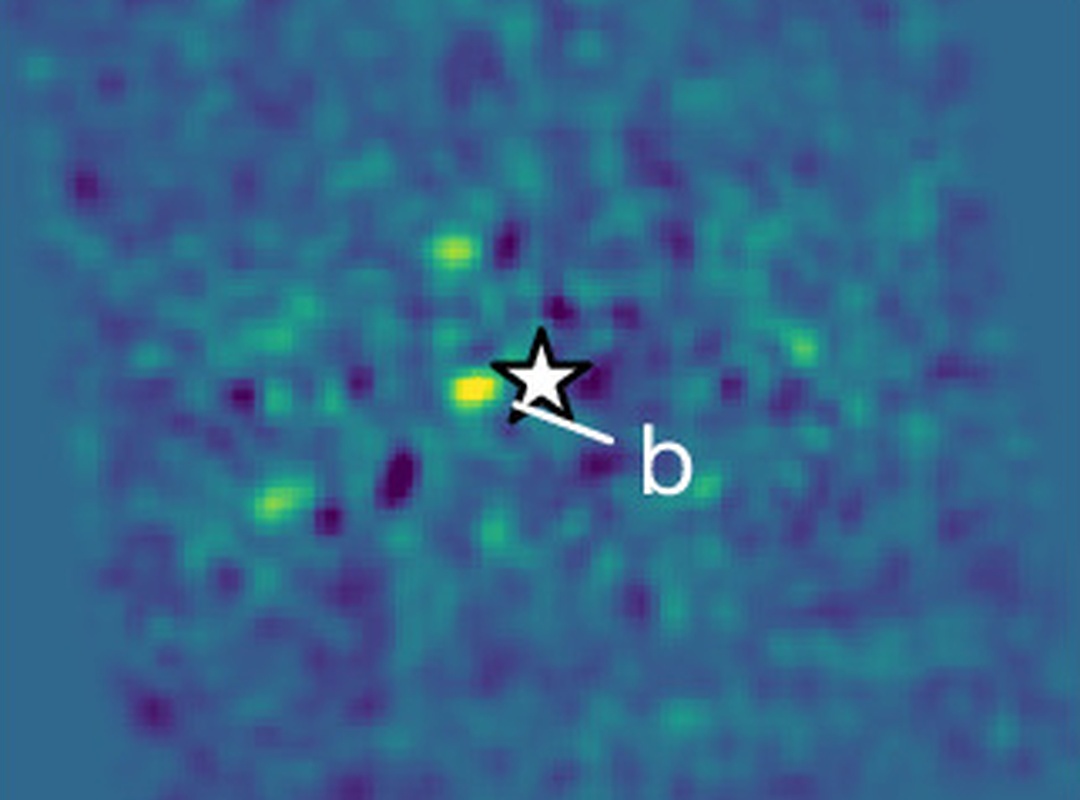
A team led by Northwestern University has found the giant planet 51 Eridani b in images the James Webb Space Telescope had already taken, at a wavelength of 4.3 microns where the standard way of removing starlight had not found it. It is the first image of the planet at that wavelength. The planet itself is not new: it was first found with telescopes on the ground.
The study, led by Rodrigo Ferrer-Chavez with colleagues at Caltech, MIT and the Space Telescope Science Institute, was published in Nature on November 4, 2026. Its subject is less the planet than the method that found it, which the team calls FLIP.
Subtracting a star's glare
A planet next to its star is lost in the star's glare. Webb's NIRCam camera carries a coronagraph, a mask that blocks most of the starlight, but the leftover glare still has to be modeled and subtracted from the image before a faint planet shows up.
The standard method, called KLIP, builds its model of the glare from images of other stars, known as reference stars. The telescope changes slightly between the reference picture and the target picture, and those small changes limit how faint a planet KLIP can find.
FLIP also starts from reference stars, but it adds a physical model of the coronagraph's optics. The team first calibrates that model on the reference images, then lets it adjust for small changes in the telescope's aberrations, the tiny flaws in how its optics focus light, until it better matches the target image. The team tuned about a million model parameters this way. Northwestern's news release calls the result a digital twin of the telescope.
From a miss to a detection
The team tested FLIP on Webb images of three stars. Two, HIP 65426 and 51 Eridani, have known planets. The third, TYC 5899, has none, so the team planted fake planets in its data to measure how much fainter a planet FLIP could pick out.
On these published Webb data, FLIP was 2 to 15 times more sensitive than the standard method as used in the original analyses. At the position of 51 Eridani b in the 4.3-micron image, sensitivity improved by a factor of about four, and the planet appeared with a signal-to-noise ratio of 6.3, a measure of how strongly it stands out from the leftover noise. In the original analysis, the standard method had detected the planet at 4.1 microns, but not at 4.3 microns or at longer wavelengths.
Why it matters
Light at 4.3 microns is infrared, far beyond the colors our eyes can see. It is where carbon dioxide absorbs light, and Earth's own atmosphere blocks that wavelength for telescopes on the ground, so only a telescope in space like Webb can look there. The team plans to measure the planet's brightness in the new image and use it to study its atmosphere and how it formed.
The method could matter more for the future. To image planets like Earth, the proposed Habitable Worlds Observatory may need optics 100 to 1,000 times more stable than Webb's. If FLIP can be extended to the much fainter planets such a telescope would hunt, the authors write, that stability requirement may be partially lifted.
What is not settled
The gains were measured on three stars, all observed with one instrument, Webb's NIRCam coronagraph. A model this flexible can also remove some of a planet's own light, the authors found. They planted fake planets in each image to measure that loss and stopped the fitting early to limit it, and farther from the star FLIP sometimes lost more planet signal than the standard method.
The benefit for a future Earth-imaging telescope is conditional, and the authors say it holds only if FLIP can be extended to the much fainter planets such a telescope would look for. The new detection of 51 Eridani b is a first step, and the measurements of its atmosphere at 4.3 microns are still to come.
By the numbers
- Wavelength of the new image
- 4.3 microns a carbon dioxide band that ground telescopes cannot use [1]
- Signal-to-noise ratio of the detection
- 6.3 [1]
- Sensitivity gain at the planet's position
- about 4 times [1]
- Sensitivity gain on the Webb data tested
- 2 to 15 times [1]
- Stars tested
- three one with planted fake planets [1]
- Stability a future Earth-imaging telescope may need
- 100 to 1,000 times Webb's [1]
See 51 Eridani yourself
You cannot see the planet, but you can see its star. 51 Eridani, in the constellation Eridanus, is about 97 light-years away. At magnitude 5.2 it is faint, visible to the unaided eye only away from city lights. In mid-November it climbs the southeast in the late evening, about 11 degrees up and to the right of Rigel, the bright star at Orion's foot. The Moon was new on November 9, so the evenings that follow are dark.
- Brightness
- magnitude 5.2
- From New York, Nov 10 at 11 pm
- 37 degrees up, southeast
- Guide star
- about 11 degrees from Rigel, up and to the right
- Moon
- new on Nov 9, below the horizon
Computed by CycleCalcs with Astronomy Engine for New York (40.71 N, 74.01 W) at 11 pm EST on November 10, 2026, from the star's Gaia DR3 position.
Explore it on CycleCalcs
Sources
- Primary source R. Ferrer-Chavez, J. J. Wang, K. L. Bouman, W. T. Freeman, L. Pueyo, B. Y. Feng and M. D. Perrin, "Imaging exoplanets below the telescope stability limit," Nature 659, 58-62 (2026), doi:10.1038/s41586-026-11213-z
- Primary source The same paper, open access full text, Europe PMC PMC13736631
- Background Northwestern University, "Hidden planet emerges from the glare," news release, November 4, 2026
- Background Phys.org, "Giant planet emerges from two-year-old JWST data thanks to glare-removal technique," November 4, 2026
- Independent report Universe Today, "Exoplanets Can't Hide From The JWST's 'Digital Twin'," November 2026
- Background Nature Asia, "Astronomy: Suppressing starlight to hunt exoplanets," press release, November 5, 2026
- Background W. O. Balmer et al., "JWST-TST High Contrast: Living on the Wedge, or, NIRCam Bar Coronagraphy Reveals CO2 in the HR 8799 and 51 Eri Exoplanets' Atmospheres," The Astronomical Journal 169, 209 (2025), the original Webb analysis
- Data STScI, JWST User Documentation, NIRCam Filters
- Data Wikipedia, 51 Eridani (position, brightness and distance of the star)
Images: Ferrer-Chavez et al., Nature 659, 58-62 (2026) (CC BY 4.0); Ferrer-Chavez et al., Nature 659, 58-62 (2026), with column titles added by CycleCalcs (CC BY 4.0).