Solar SystemPeer-reviewed: Geophysical Research Letters
Perseverance finds corundum, the mineral of rubies, on Mars
The rover's SuperCam laser made chromium in three small rocks on the rim of Jezero crater glow red at two wavelengths that mark corundum. The grains are too small to see, and no gems have turned up.
The short version
- NASA's Perseverance rover identified corundum, the mineral of rubies and sapphires, on Mars for the first time, in three small rocks on the rim of Jezero crater.
- SuperCam's laser made chromium in the mineral glow red at 692.7 and 694.1 nanometers. In one rock the glow had a lifetime of about 3 milliseconds, or three thousandths of a second, between two rubies measured on Earth.
- The grains are too small for SuperCam's camera to pick out, and no gem-sized rubies have been found.
- The team favors metamorphism caused by a large impact, likely with fluids at some stage, and does not exclude other origins.
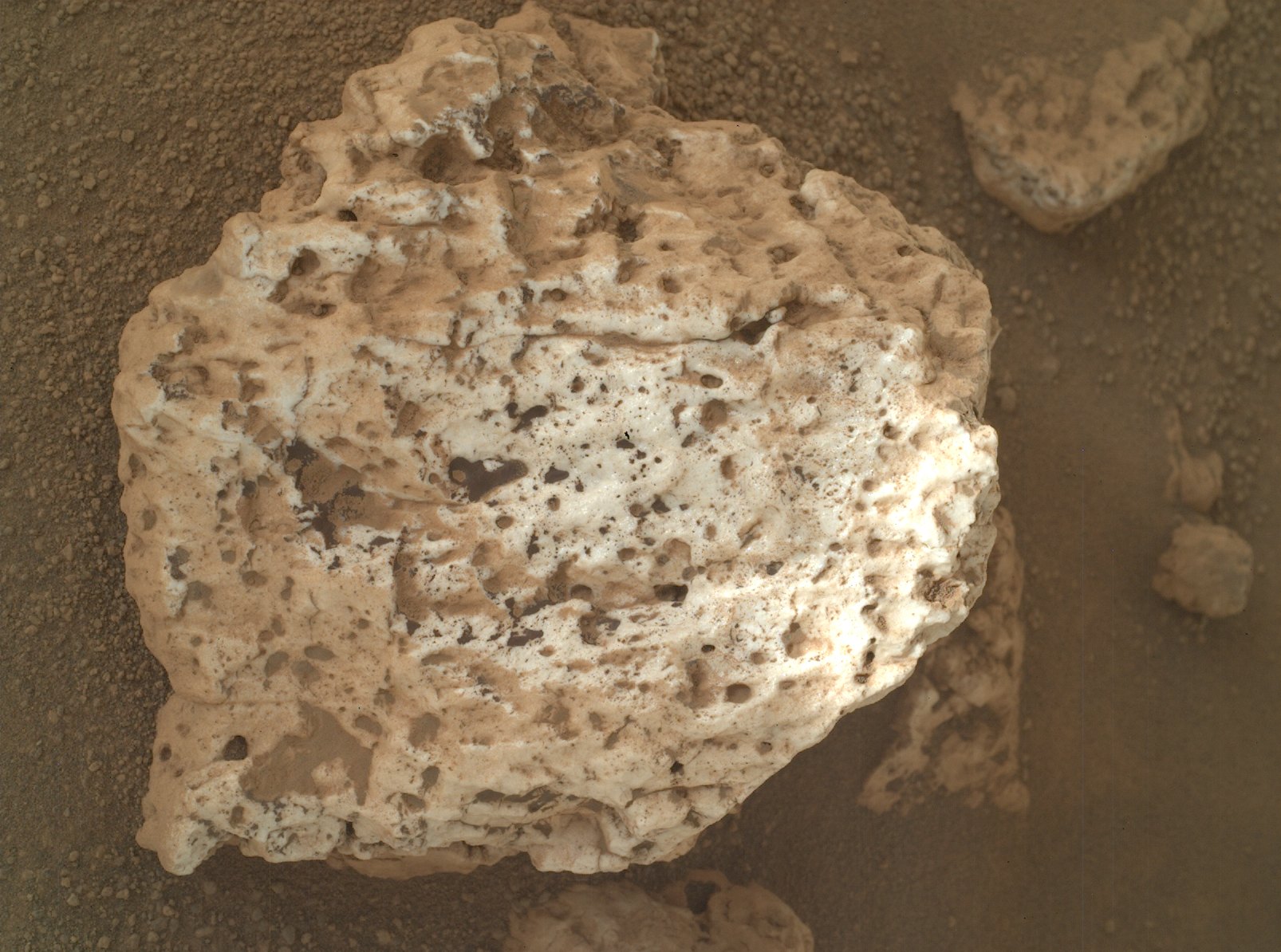
NASA's Perseverance rover has identified corundum on Mars for the first time. Corundum is the mineral of rubies and sapphires, and until now it had not been identified on Mars from orbit, by a rover or lander on the ground, or in a meteorite from Mars.
The result comes from the team behind SuperCam, a laser instrument on the rover, in a study led by Ann Ollila. Their peer-reviewed paper was first published in Geophysical Research Letters on August 11, 2026. In a NASA blog post titled "Rubies on Mars?" and dated November 4, 2026, SuperCam's principal investigator, Roger Wiens of Purdue University, a co-author of the paper, described the find.
No one has found a gem. The corundum is in grains too small for SuperCam's camera to pick out. The team estimates they are smaller than about 200 to 375 microns across, the finest detail the camera could resolve from 2.4 to 5 meters away. A micron is a thousandth of a millimeter, so even the largest possible grain is less than four tenths of a millimeter wide.
A red glow at night
Pure corundum is colorless. Chromium makes it red, which is ruby, and iron and titanium give sapphire its blue. Chromium also does something useful for a rover: when laser light hits it inside corundum, it glows.
The corundum turned up in three centimeter-sized rocks, named Hampden River, Coffee Cove and Smiths Harbor. They are light-toned float rocks, a geologist's term for loose pieces that are no longer attached to bedrock. Two lay a few meters apart, and the third was about 100 meters (about 330 feet) to the south.
SuperCam studied them with a technique called time-resolved luminescence. At night, it fires a pulsed laser with a wavelength of 532 nanometers at a rock, then records the light the rock gives off in response and how long that light lasts. A nanometer is a billionth of a meter.
In all three rocks, that light had two strong, narrow peaks at 692.7 and 694.1 nanometers. This is red light, near the 700-nanometer end of what the eye can see, and it comes from chromium in corundum. Where the two main peaks were strong, weaker corundum lines also appeared at about 699.4, 701.5, 704.7 and 707.3 nanometers.
The timing added to the case. After the laser fired, the glow from Smiths Harbor faded with a lifetime of about 3 milliseconds, or three thousandths of a second. A lifetime is a measure of how quickly the light dies away. That value falls between those of two ruby samples measured on Earth, and the team calls it the final piece of evidence for corundum.
The glow needs only a trace of chromium, and sapphire measured in the laboratory gives a matching signal, so the result does not tell the team what color the Martian grains are.
A mineral that needs heat
Corundum forms where rock is rich in aluminum and poor in silicon, and it needs temperatures above about 350 to 400 degrees Celsius (about 660 to 750 degrees Fahrenheit). That kind of heat and pressure is found in deep magma, or in shallower rock heated by tectonic processes or by meteorite impacts.
Wiens writes that corundum is a mineral the team would not expect to find on Mars, a planet that lacks plate tectonics. Plate tectonics is the slow movement of the large plates that make up Earth's surface. Where one plate sinks under another, rock is carried down and heated, which is one way Earth makes corundum. The paper puts the Mars side more carefully: there is no conclusive evidence that plate tectonics ever occurred there.
The team's favored explanation is metamorphism, the changing of rock by heat and pressure, caused by a large impact, likely with fluids at some stage. The three rocks lie near rocks the team interprets as impact breccias, which are rocks made of broken fragments, on the rim of Jezero, itself an impact crater 45 kilometers (about 28 miles) wide.
What is not settled
The identification rests on one technique. SuperCam's chemistry and Raman measurements of the same rocks showed no sign of corundum, which the team takes to mean the grains are small, rare or both. The authors argue that the two peaks and their lifetime are distinctive enough to identify the mineral on their own.
How the corundum formed is also open. The authors call impact metamorphism the most plausible scenario, but they describe the evidence as sparse and the case for an impact as circumstantial, and they do not exclude other origins. Corundum can also form in magma, or where fluids move elements between two different kinds of rock.
The three rocks are loose pieces, not bedrock. The paper covers rocks analyzed through early July 2025, so anything the rover has measured since then is not in it.
The team says a core sample from a corundum-bearing outcrop, returned to Earth, could settle how the mineral formed. For now, the rover often turns the same technique on light-toned rocks, looking for more evidence of what impacts did to this ancient terrain.
By the numbers
- Rocks with corundum
- three Hampden River, Coffee Cove and Smiths Harbor [1]
- Wavelength of SuperCam's laser
- 532 nanometers [1]
- Strong lines from chromium in corundum
- 692.7 and 694.1 nanometers red light [1]
- Lifetime of the glow in Smiths Harbor
- about 3 milliseconds between two ruby samples measured on Earth [1]
- Upper limit on grain size
- smaller than about 200 to 375 microns less than four tenths of a millimeter [1]
- Temperature corundum needs to form
- above about 350 to 400 degrees Celsius about 660 to 750 degrees Fahrenheit [1]
- Width of Jezero crater
- 45 kilometers about 28 miles [1]
See Mars yourself
You cannot see Jezero crater without a spacecraft, but Mars itself is easy to find before dawn this week. From New York it rises at about 11:23 pm on November 10, and by 5 am on November 11 it stands about 59 degrees up in the southeast, in the constellation Leo. Find bright Jupiter first: Mars is the fainter point about 2 degrees above it, and the two draw closer through the week. Regulus, the brightest star of Leo, is about 7 degrees to the lower left of Mars. The Moon was new on November 9, so it is out of the way.
- From New York, Nov 11 at 5 am
- 59 degrees up, southeast
- Rises
- about 11:23 pm EST on Nov 10
- Nearest bright guide
- Jupiter, about 2 degrees below Mars
- Guide star
- Regulus, about 7 degrees to the lower left
- Moon
- new on Nov 9, below the horizon
Computed by CycleCalcs with Astronomy Engine for New York (40.71 N, 74.01 W) at 5 am EST on November 11, 2026.
Explore it on CycleCalcs
- Mars tonightSee when Mars rises and sets for your location, and when its next opposition comes.
- Mars and Jupiter conjunctionsMars and Jupiter are about 2 degrees apart on the morning of November 11 and drawing closer through the week. This page follows their meetings.
- Live sky mapFind Mars, Jupiter and Regulus over your own location at any hour.
Sources
- Primary source A. M. Ollila et al., "Corundum Discovered by SuperCam and the Perseverance Rover at Jezero Crater, Mars," Geophysical Research Letters 53(16), e2026GL122537 (2026), doi:10.1029/2026GL122537, open access
- Independent report Michelle Starr, "'Very Unexpected': NASA Rover Zapped a Rock on Mars And Found a Gemstone Surprise," ScienceAlert, August 13, 2026
- Background Roger C. Wiens (SuperCam principal investigator and a co-author of the paper), "Rubies on Mars?" NASA Science Perseverance blog, November 4, 2026
- Background NASA Science, "Visible Light" (the wavelengths the eye can see)
Images: NASA/JPL-Caltech (public domain, U.S. government work).