The tritos
What eclipse rhythm returns after 11 years less a month?
The tritos is an eclipse recurrence cycle that runs a little under eleven years, 3,986.63 days, or about 10 years and 334 days. Count 135 new moons from an eclipse and the Sun, Moon and a lunar node fall back into nearly the same arrangement, so a similar eclipse occurs. It is one of several intervals shorter than the familiar 18-year Saros that let observers anticipate eclipses without waiting a full Saros step.
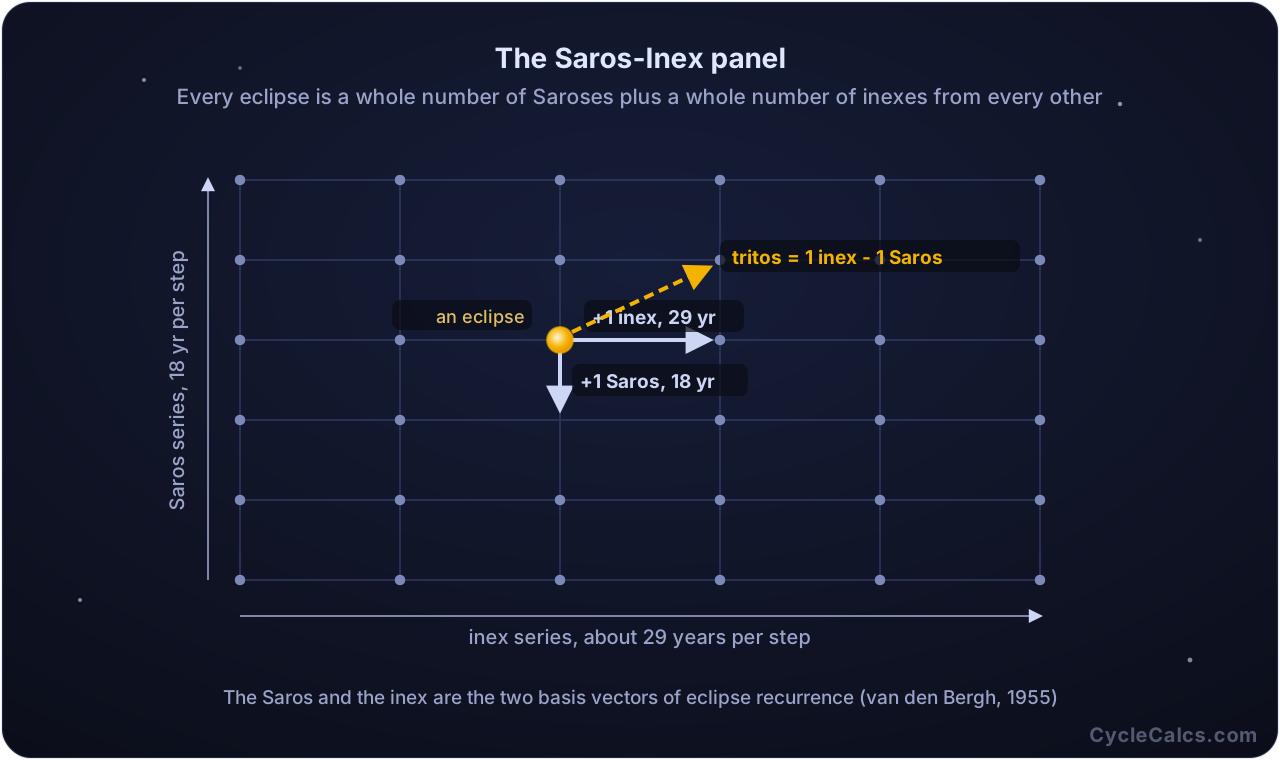
Its defining feature is an exact piece of bookkeeping: one tritos equals one inex minus one Saros. In days that reads 10,571.95 minus 6,585.32, which leaves 3,986.63. The same subtraction works in whole months, 358 minus 223 synodic months, and it lands on 135. That places the tritos as the natural short step sitting between successive Saros returns.
How it works, in plain language: Why eclipses happen. This page carries the numbers.
On this page
The Annular solar eclipse of February 6, 2027 (Saros series 131) has a near-twin one tritos later, on January 5, 2038, in Saros series 132, the next series along.
One tritos runs about 10 years 334 days (10.915 years). It carries half a draconic month, so the eclipse recurs at the opposite node, one Saros series further on.
Where we are in the tritos right nowbaked daily
Track the tritos from the annular solar eclipse of February 6, 2027 (Saros series 131): one tritos later, a matching eclipse falls on January 5, 2038 in Saros series 132. The table below steps three cycles ahead.
These eclipse dates are computed from the open-source Astronomy Engine and refreshed by the daily almanac build. See every cycle together on the cosmic clock.
The tritos at a glance
| Period | 3,986.63 days |
|---|---|
| In years | about 10 yr 334 d (10.915 yr) |
| Synodic months | 135 |
| Draconic months | 146.5 (carries a half) |
| Eclipse years | 11.5 |
| Relation | one inex minus one Saros |
| Node behavior | alternates each return |
| Use | short-interval eclipse prediction |
Sources: NASA Eclipse Web Site (Espenak and Meeus).
The tritos in every unit
The same 3,986.63-day span written several ways, and as the difference of two larger eclipse cycles.
| In days | 3,986.63 d |
|---|---|
| In tropical years | 3,986.63 / 365.2422 = 10.915 yr |
| Calendar span | 10 years 334 days |
| Synodic months | 135 x 29.530589 d = 3,986.63 d |
| Draconic months | 146.5 x 27.212221 d = 3,986.6 d |
| Eclipse years | 11.5 x 346.62 d = 3,986.1 d |
| Inex minus Saros | 10,571.95 d - 6,585.32 d = 3,986.63 d |
| In whole months | 358 - 223 = 135 synodic months |
Period from the NASA Eclipse Web Site (Espenak and Meeus); one tritos is 3,986.63 days. The synodic product is exact to the stated month length of 29.530589 days; the draconic and eclipse-year products use mean month values and round to within a day, and the counts 146.5 and 11.5 are the nearest half-integers.
What the tritos is and how it arises
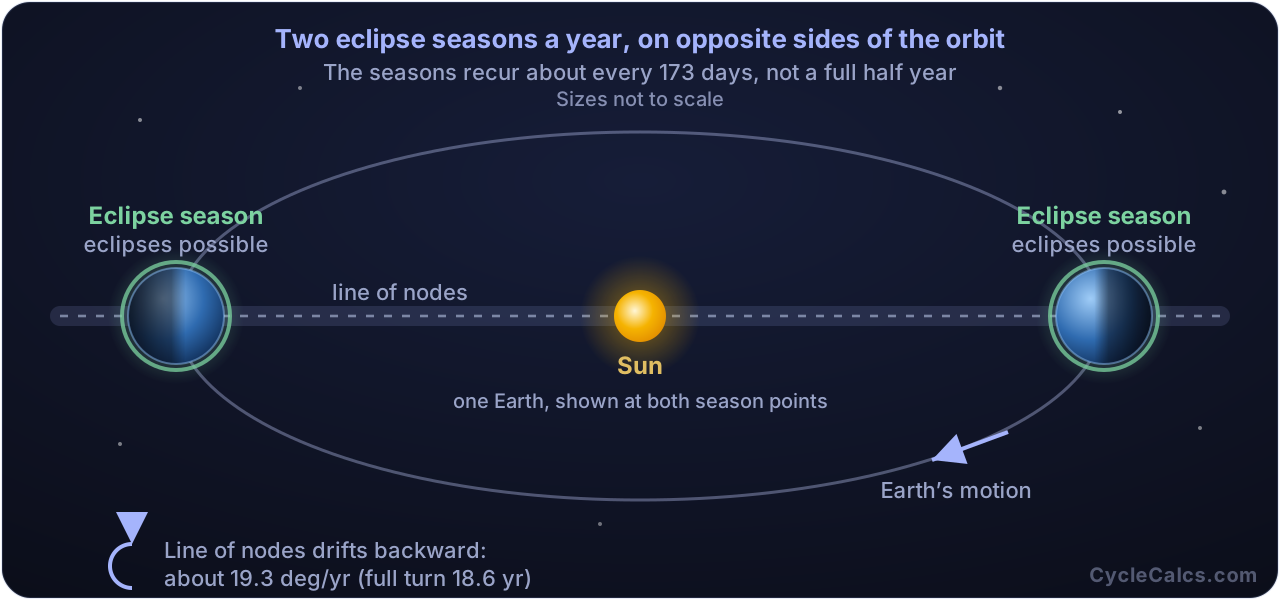
An eclipse needs three conditions at once: the Moon at new or full, the Moon near a node so the three bodies line up, and enough repetition of that geometry that a family of similar eclipses forms. The tritos is the interval over which 135 synodic months of 29.530589 days come back into step with a near-whole count of draconic months, the time between successive passages through the same node. Multiply 135 by 29.530589 and the total is 3,986.63 days.
The draconic count is 146.5, not a whole number, and that half month matters. After one tritos the Moon has crossed the node line an extra half turn, so if one eclipse of a series falls at the ascending node the next falls near the descending node, and the pattern alternates from there. This is the same node-swapping behavior seen in the inex, and it separates the tritos from the Saros, whose 242 draconic months hold every return at the same node.
A tritos series is moderately long-lived. Its eclipses drift across the Earth and change in character more slowly than a Saros but faster than the very slow inex, so the tritos occupies a middle ground between the two. Babylonian and later astronomers tracked intervals like this to predict eclipses at spacings shorter than the Saros, and modern eclipse catalogs still index tritos relationships when sorting eclipses into families.
The math
The arithmetic is direct. One synodic month is 29.530589 days, so 135 of them make 135 x 29.530589 = 3,986.63 days. The draconic month is 27.212221 days, and 146.5 of those give 146.5 x 27.212221 = 3,986.6 days, which agrees to within a fraction of a day. Because the draconic figure carries a half, the node alternates each return; because both counts fill the same span, the eclipse repeats.
Written as a difference of cycles, the inex is 358 synodic months, or 10,571.95 days, and the Saros is 223 synodic months, or 6,585.32 days. Subtract: 10,571.95 minus 6,585.32 equals 3,986.63 days, and 358 minus 223 equals the 135 months of the tritos. To watch how eclipses in a family creep across the calendar and around the globe, step through them in the eclipse explorer.
The same eclipse, stepped on by the tritos
| Solar eclipse | Steps on | Type | Saros series |
|---|---|---|---|
| Feb 6, 2027 | Anchor eclipse | Annular | Series 131 |
| Jan 5, 2038 | 1 x tritos | Annular | Series 132 |
| Dec 5, 2048 | 2 x tritos | Total | Series 133 |
| Nov 5, 2059 | 3 x tritos | Annular | Series 134 |
How the tritos relates to other cycles
The tritos sits in a small family of eclipse periods that are all sums or differences of one another. It is exactly one inex minus one Saros, which is why its length, just under eleven years, falls between the 18-year Saros and the 29-year inex. Add a tritos back to a Saros and the result is an inex; the three lock together through simple whole-month counts.
Two neighboring pages fill out the picture. The exeligmos is three Saroses, the cycle that brings an eclipse back to nearly the same longitude, and the draconic month is the node-referenced orbit whose half-integer count gives the tritos its alternating nodes. For how phase, node and shadow combine to make any eclipse at all, see the lesson on how eclipses work.
Frequently asked questions
How long is the tritos eclipse cycle?
One tritos is 3,986.63 days, which is about 10 years and 334 days, or 10.915 tropical years. That length comes from 135 synodic months of 29.530589 days each. It is shorter than the 18-year Saros and much shorter than the 29-year inex, which makes the tritos a useful short step for anticipating eclipses without waiting a full Saros to pass.
What is the tritos in eclipse prediction?
The tritos is a recurrence cycle of 3,986.63 days over which similar eclipses repeat. After 135 new or full moons the Sun, Moon and a lunar node return to nearly the same arrangement, so an eclipse much like the first occurs. Babylonian and later astronomers used intervals like this, a little under eleven years, to forecast eclipses at spacings shorter than the 18-year Saros.
How is the tritos related to the Saros and inex?
The tritos equals one inex minus one Saros. In days that is 10,571.95 minus 6,585.32, which leaves 3,986.63 days. In whole months it is 358 minus 223, giving 135 synodic months. So the tritos is the short interval that sits between Saros returns, and adding a tritos to a Saros returns the full inex of about 29 years.
Do tritos eclipses stay at the same node?
No. A tritos spans 146.5 draconic months, and that half month flips the geometry. If one eclipse in a tritos series happens at the ascending node, the next happens near the descending node, and the series alternates from there. This node-swapping is the same behavior seen in the inex, and it is what separates the tritos from the Saros, whose 242 draconic months hold every eclipse at one node.
Why is the tritos about eleven years long?
Because 135 synodic months come to 3,986.63 days, which is 10 years and 334 days, close to but a little under eleven years. That count is set by the inex-minus-Saros arithmetic: 358 months minus 223 months equals 135. The span is long enough for the Sun and Moon to realign at a node, yet short enough to serve as an intermediate step between 18-year Saros returns.
When does an eclipse repeat after one tritos?
Starting from the solar eclipse of February 6, 2027 in Saros series 131, a matching eclipse returns one tritos later, on January 5, 2038, in Saros series 132. Because the tritos carries half a draconic month, the new eclipse falls at the opposite node, one Saros series further on. These dates are computed from Astronomy Engine.
Keep exploring
- The inex: the longer eclipse cycle the tritos is carved from
- The Saros: the 18-year eclipse rhythm
- The exeligmos: three Saroses, same-longitude return
- How eclipses work: phase, node and shadow together
- Eclipse explorer: step through eclipse families