The inex
What ties one Saros series to the next?
The inex is one of the two principal eclipse cycles, the long-lived partner of the Saros. One inex is 10,571.95 days, about 28 years and 345 days, and it is built from exactly 358 synodic months. Step one inex forward from any eclipse and a very similar eclipse returns, but with one twist the Saros never shows: it lands at the other lunar node, throwing the eclipse track to the opposite hemisphere in latitude.
That half-node offset is the signature of the inex, and it buys exceptional stability. Where a Saros series lives about 1,200 to 1,550 years before it fades, an inex series can persist for roughly 23,000 years, its eclipses drifting only slowly in latitude rather than dying out. Together the Saros and the inex are the two axes on which every eclipse in the catalog can be filed, an idea the Eclipse and Saros Explorer sets out member by member.
How it works, in plain language: Why eclipses happen. This page carries the numbers.
On this page
The Annular solar eclipse of February 6, 2027 (Saros series 131) has a near-twin one inex later, on January 16, 2056, in Saros series 132, the next series along.
One inex runs about 28 years 345 days (28.945 years). It carries half a draconic month, so the eclipse recurs at the opposite node, one Saros series further on.
Where we are in the inex right nowbaked daily
Track the inex from the annular solar eclipse of February 6, 2027 (Saros series 131): one inex later, a matching eclipse falls on January 16, 2056 in Saros series 132. The table below steps three cycles ahead.
These eclipse dates are computed from the open-source Astronomy Engine and refreshed by the daily almanac build. See every cycle together on the cosmic clock.
The inex at a glance
| Period | 10,571.95 days (about 28 years 345 days) |
|---|---|
| In years | about 28 years 345 days (28.945 tropical years) |
| Synodic months | 358 exactly |
| Draconic months | 388.5 (the half throws the eclipse to the other node) |
| Eclipse years | 30.5 (346.62 days each) |
| Node behavior | alternates every cycle to the opposite node |
| Series length | up to about 23,000 years |
| Named by | G. van den Bergh, 1955 |
Sources: NASA Eclipse Web Site (Espenak and Meeus).
The inex in every unit
One inex is best understood by writing it several ways at once, in plain units and as whole counts of the lunar months and the neighboring eclipse cycles.
| In days | 10,571.95 days |
|---|---|
| In calendar time | about 28 years 345 days |
| In tropical years | 28.945 years |
| Synodic months (phase) | 358 exactly (358 x 29.530589 d = 10,571.95 d) |
| Draconic months (node) | 388.5 (388.5 x 27.212221 d = 10,571.95 d) |
| Eclipse years | 30.5 (30.5 x 346.620 d = 10,571.9 d, rounded) |
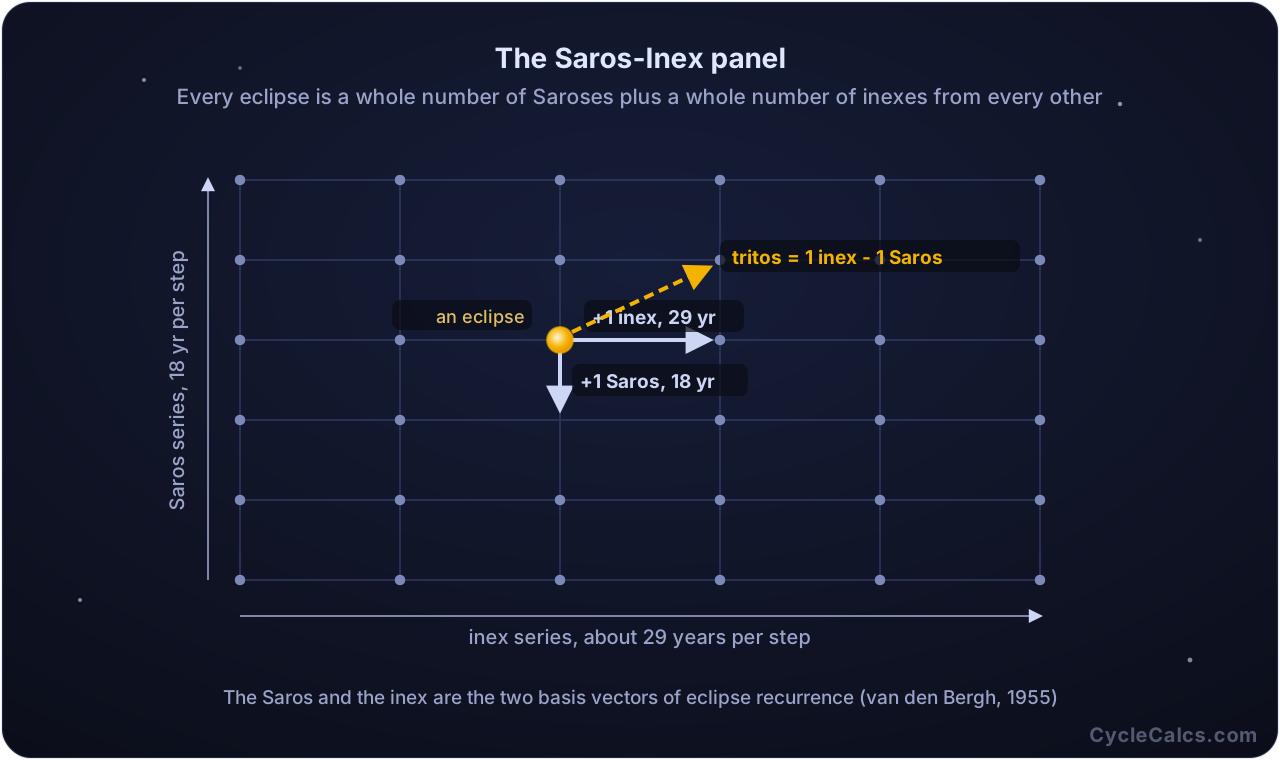
| As Saros-Inex basis vectors | one whole step along the inex axis of van den Bergh's grid |
| One inex minus one Saros | 10,571.95 d - 6,585.32 d = 3,986.63 d (one tritos) |
Periods from the NASA Eclipse Web Site (Espenak and Meeus) and Jean Meeus, Astronomical Algorithms. The draconic count of 388.5 is a half month exactly, and that half is what throws the next eclipse to the opposite node; the eclipse-year total is rounded.
What the inex is and how it arises
Like the Saros, the inex is an interval over which the Moon returns close to the same eclipse geometry. It runs 358 synodic months, so the Moon is back to the same phase, new for a solar eclipse or full for a lunar one. The decisive difference lies in the node count. A Saros spans 242 draconic months, a whole number, so the eclipse returns to the same node. An inex spans 388.5 draconic months, and that half month is everything.
Because the draconic count carries a half, the Moon arrives at the opposite node one inex later. An eclipse near the ascending node returns as an eclipse near the descending node, and its track jumps from one hemisphere of latitude to the other. Yet the geometry is otherwise so well preserved that successive eclipses one inex apart barely change in size or character. They creep slowly across latitude instead of fading, which is why an inex series can outlast a Saros series many times over, up to about 23,000 years.
This is where van den Bergh's insight enters. In 1955 he showed that every known eclipse can be placed on a two-dimensional grid: its Saros series number along one axis, its inex series number along the other. Any interval between two eclipses can then be written as a whole number of Saroses plus a whole number of inexes. The Saros and the inex are, in effect, the two basis vectors of eclipse recurrence, and the resulting Saros-Inex panel organizes the entire catalog of past and future eclipses on a single chart.
The math
The make-up is exact where it needs to be and revealing where it is not. In synodic months, 358 x 29.530589 d = 10,571.95 d. In draconic months, 388.5 x 27.212221 d = 10,571.95 d. In eclipse years, 30.5 x 346.620 d = 10,571.9 d, rounded. The synodic and draconic totals agree to a fraction of a day, so phase and node realign together; the crucial figure is the .5 in 388.5, the half node crossing that sends the next eclipse to the opposite node.
The inex also anchors the neighboring cycles by simple subtraction. One inex minus one Saros is 10,571.95 d - 6,585.32 d = 3,986.63 d, which is the tritos. Because the residual drift accumulated in a single inex is so small, an inex series stays coherent for tens of thousands of years, far longer than any Saros. To walk real eclipse families and see how the two numbers file each event, open the Eclipse and Saros Explorer.
The same eclipse, stepped on by the inex
| Solar eclipse | Steps on | Type | Saros series |
|---|---|---|---|
| Feb 6, 2027 | Anchor eclipse | Annular | Series 131 |
| Jan 16, 2056 | 1 x inex | Annular | Series 132 |
| Dec 27, 2084 | 2 x inex | Total | Series 133 |
| Dec 8, 2113 | 3 x inex | Annular | Series 134 |
How the inex relates to other cycles
The inex is best read against its partner the Saros. Both return a near-twin eclipse, but the Saros repeats at the same node and lives about 1,200 to 1,550 years, while the inex repeats at the opposite node and can last around 23,000 years. Subtract one from the other and you reach the tritos of 3,986.63 days; stack three Saroses instead and you reach the exeligmos, which restores longitude as well as geometry. The Saros and the inex together classify every entry in the eclipse catalog.
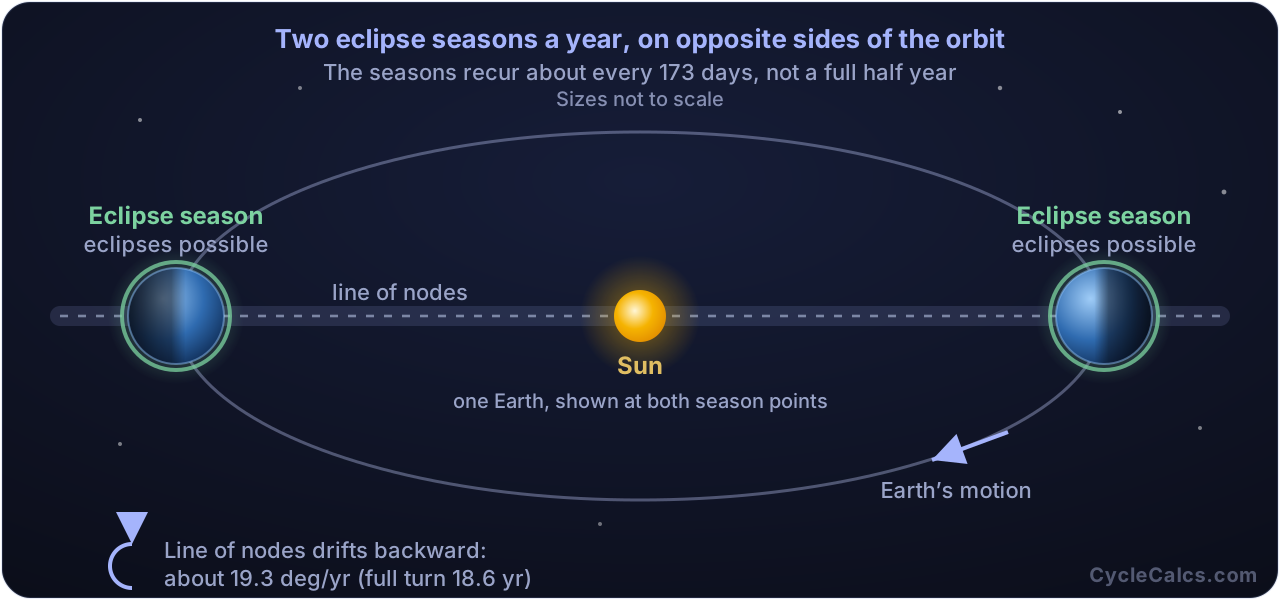
The half month that flips the node is a feature of the draconic month, the 27.212221-day return of the Moon to the same node and the reason eclipses come in seasons at all. For the underlying picture of how the Sun, Earth and Moon must line up, see the eclipses lesson, and to place any real eclipse on its Saros and inex series, use the Eclipse and Saros Explorer. Every one of these periods is laid out by length on the full cycles list.
Frequently asked questions
How long is the inex eclipse cycle?
One inex is 10,571.95 days, or about 28 years and 345 days, which is 28.945 tropical years. It is built from exactly 358 synodic months, the new-moon-to-new-moon month of 29.530589 days. After one inex a very similar eclipse recurs, though it falls at the opposite lunar node, so its track shifts to the other hemisphere in latitude.
What is the difference between the Saros and the inex?
Both are eclipse cycles that return a near-twin eclipse, but they differ in two ways. The Saros spans 223 synodic months, repeats at the same node, and its series last about 1,200 to 1,550 years. The inex spans 358 synodic months, repeats at the opposite node because it carries a half draconic month, and its series can persist for roughly 23,000 years.
Why do inex eclipse series last so long?
Because the drift built up in a single inex is very small. After 358 synodic months the eclipse geometry is almost perfectly restored, so successive eclipses one inex apart barely change in size or character. They creep slowly across latitude rather than fading, which lets an inex series persist for up to about 23,000 years, far longer than the 1,200 to 1,550 years typical of a Saros series.
What is the Saros-Inex panel?
It is a two-dimensional chart, devised by G. van den Bergh in 1955, that files every eclipse by two numbers: its Saros series along one axis and its inex series along the other. Any interval between two eclipses can be written as a whole number of Saroses plus a whole number of inexes, which makes the Saros and the inex the two basis vectors of eclipse recurrence.
Who discovered the inex cycle?
The modern inex framework is due to the Dutch astronomer G. van den Bergh, who set it out in 1955 using eclipse periods of the kind NASA now tabulates through the work of Espenak and Meeus. He paired the inex with the Saros as the two basis cycles that, between them, file every eclipse in the catalog. One inex is 10,571.95 days, about 28 years and 345 days.
When does an eclipse repeat after one inex?
Starting from the solar eclipse of February 6, 2027 in Saros series 131, a matching eclipse returns one inex later, on January 16, 2056, in Saros series 132. Because the inex carries half a draconic month, the new eclipse falls at the opposite node, one Saros series further on. These dates are computed from Astronomy Engine.
Keep exploring
- The Saros: the same-node partner of 18 years 11 days
- The tritos: one inex minus one Saros, 3,986.63 days
- The draconic month: the node-to-node month whose half flips the hemisphere
- Eclipses lesson: how the Sun, Earth and Moon line up
- Eclipse and Saros Explorer: place any eclipse on its Saros and inex series