The exeligmos
When does an eclipse come back to nearly the same place on Earth?
The exeligmos is the triple Saros, three Saros cycles laid end to end. It runs 19,755.96 days, about 54 years and 33 days. Like a single Saros it returns the Sun, the Moon and a lunar node to nearly the same alignment, so a near-twin of an earlier eclipse takes place. What sets it apart is where that eclipse lands. It restores not just the geometry in the sky but nearly the same part of the Earth below.
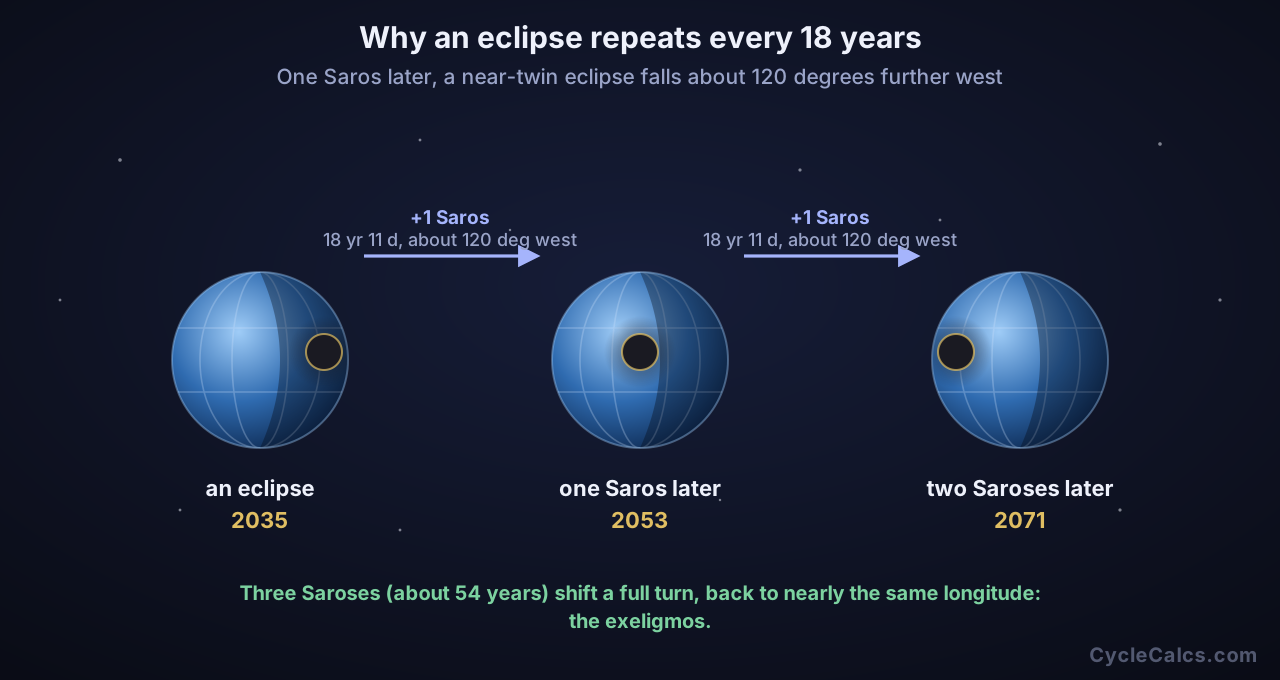
A single Saros runs about a third of a day, roughly 8 hours, past a whole number of days. In that extra third of a rotation the Earth turns about 120 degrees, so each eclipse in a series falls a third of the way around the world to the west of the one before. Wait three Saroses and those three thirds of a day add up to one whole extra day, a full 360 degrees. The eclipse comes home, back to the longitude band it visited 54 years earlier. That homecoming is the exeligmos, a cycle the Greek eclipse reckoners already knew.
How it works, in plain language: Why eclipses happen. This page carries the numbers.
On this page
Step the Annular solar eclipse of February 6, 2027 forward one exeligmos, three Saroses, and it recurs on March 10, 2081, in the same Saros series 131, over nearly the same part of the Earth.
One exeligmos runs about 54 years 33 days (three Saroses). Three Saroses add up to a whole extra day of Earth's rotation, so the eclipse comes home to almost the same longitude, not just the same geometry in the sky.
Where we are in the exeligmos right nowbaked daily
Track the exeligmos from the annular solar eclipse of February 6, 2027 (Saros series 131): one exeligmos later, a matching eclipse falls on March 10, 2081 in Saros series 131. The table below steps three cycles ahead.
These eclipse dates are computed from the open-source Astronomy Engine and refreshed by the daily almanac build. See every cycle together on the cosmic clock.
The exeligmos at a glance
| Period | 19,755.96 days |
|---|---|
| Equals | 3 Saroses |
| In years | about 54 yr 33 d (54.09 tropical years) |
| Synodic months | 669 |
| Draconic months | 726 |
| Anomalistic months | 717 |
| Eclipse years | about 57 |
| Effect | the eclipse returns to nearly the same longitude on Earth |
Sources: NASA Eclipse Web Site (Espenak and Meeus).
The exeligmos in every unit
Because the exeligmos is exactly three Saroses, every count that nearly fills one Saros simply triples, and its single loose third of a day becomes a whole day.
| In days | 19,755.96 d |
|---|---|
| In calendar time | about 54 years 33 days (54.09 tropical years) |
| Equals | exactly 3 Saroses (3 x 6,585.3213 d = 19,755.96 d) |
| Synodic months (new moon to new moon) | 669 x 29.530589 d = 19,755.96 d |
| Draconic months (node to node) | 726 x 27.212221 d = 19,756.07 d |
| Anomalistic months (perigee to perigee) | 717 x 27.554550 d = 19,756.61 d |
| Eclipse years | about 57 (57 x 346.620 d = 19,757.34 d) |
| Accumulated Earth rotation | 3 x 8 h = 24 h, one whole extra day (360 degrees) |
Periods from the NASA Eclipse Web Site (Espenak and Meeus) and Jean Meeus, Astronomical Algorithms, with one Saros taken as 6,585.3213 days. The draconic, anomalistic and eclipse-year totals run from a fraction of a day to about a day and a half past the synodic total; those small residuals are inherited from the Saros and are why even a tripled cycle slowly drifts.
What the exeligmos is and how it arises
Start from the Saros. After 6,585.32 days the Moon has completed 223 whole cycles of phase, very nearly 242 whole cycles of node crossing, and very nearly 239 whole cycles of distance, so the geometry of an eclipse repeats almost exactly. The one thing the Saros does not restore is where on Earth the eclipse is seen. Its length is not a whole number of days: it overshoots by about a third of a day, and a third of a day is a third of a rotation.
That leftover third of a rotation carries each eclipse westward. When the next member of a Saros series arrives, the Earth has spun an extra 120 degrees, so the ground track slides roughly a third of the way around the planet. Three eclipses on, three of those thirds have accumulated into a full 360-degree turn. The Earth is back under the same longitude, and the eclipse returns not only to the same geometry in the sky but to nearly the same region beneath it. The exeligmos is that threefold interval, the shortest run of Saroses that carries an eclipse cleanly back around the world.
An exeligmos does not begin a new eclipse family. It joins members of the same numbered Saros series three steps apart, so it refines the Saros rather than replacing it: same series, three eclipses on, one whole day of accumulated rotation. Greek astronomers knew the interval and called it exeligmos. The Antikythera mechanism, built around 100 BCE, carried a dedicated exeligmos dial for exactly this correction, converting a Saros eclipse prediction into the right local time and place.
The math
The exeligmos is three Saroses, so its length is simply 3 x 6,585.3213 = 19,755.96 days. Written in the lunar months that build it, the counts triple as well: 669 synodic months at 29.530589 days give 19,755.96 days, 726 draconic months at 27.212221 days give 19,756.07 days, and 717 anomalistic months at 27.554550 days give 19,756.61 days. All three totals sit within about a day of one another, the same triple near-commensurability that makes a single Saros work, carried across three of them.
The purpose of the cycle lives in the fractional part. One Saros is about 8 hours longer than a whole number of days, so three come to 3 x 8 = 24 hours, one full extra rotation of the Earth. That is why the westward drift of about 120 degrees per Saros closes to a full 360 degrees and the eclipse returns to nearly the same longitude. To step through a single Saros series member by member and watch the ground track march west, then home again three eclipses on, open the Eclipse and Saros Explorer.
The same eclipse, stepped on by the exeligmos
| Solar eclipse | Steps on | Type | Saros series |
|---|---|---|---|
| Feb 6, 2027 | Anchor eclipse | Annular | Series 131 |
| Mar 10, 2081 | 1 x exeligmos | Annular | Series 131 |
| Apr 13, 2135 | 2 x exeligmos | Annular | Series 131 |
| May 15, 2189 | 3 x exeligmos | Annular | Series 131 |
How the exeligmos relates to other cycles
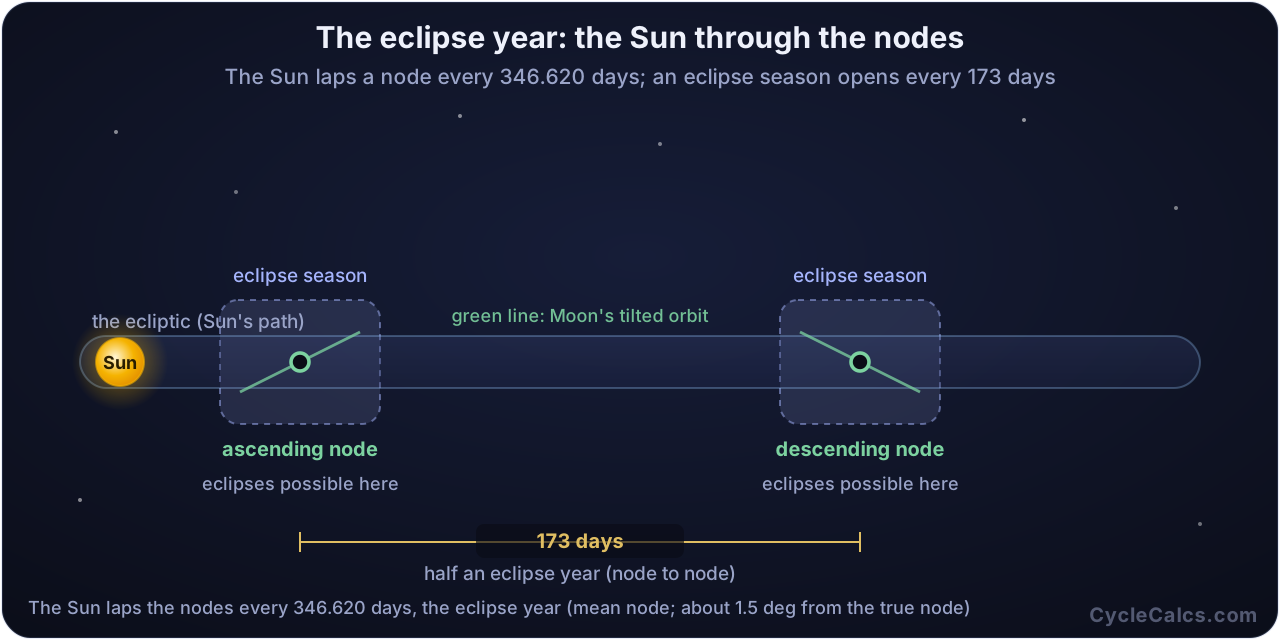
The exeligmos is built directly on the Saros. It is three of them, and it corrects the one thing the Saros leaves unfinished, the longitude of the eclipse. The Saros page treats the 18-year rhythm and the 120-degree westward shift in full; this page is the treatment of that shift's threefold cure. Both rest on the same node machinery as the eclipse year, the 346.62-day beat that opens the eclipse seasons at each lunar node.
Two other intervals navigate between Saros series rather than within one: the inex of 358 synodic months, about 29 years, and the tritos of 135 synodic months, about 11 years. Both step from one numbered series to a neighbor, and eclipse catalogers use the inex together with the Saros as a coordinate grid across every series. The exeligmos is the opposite kind of tool: it stays inside one series and moves three steps along it. For the underlying geometry of why any of these work, the eclipses lesson shows how the Sun, Earth and Moon must line up, and the Moon page tracks tonight's phase and distance.
Frequently asked questions
What is the exeligmos?
The exeligmos is the triple Saros, an eclipse cycle of 19,755.96 days, about 54 years and 33 days, equal to exactly three Saros cycles. Like the Saros it returns the Sun, Moon, and a lunar node to nearly the same alignment, so a near-twin eclipse occurs. What makes it distinct is that the eclipse also comes back to nearly the same longitude on Earth, not just the same geometry in the sky.
How long is the exeligmos?
The exeligmos is 19,755.96 days, which is about 54 years and 33 days, or 54.09 tropical years. It equals exactly three Saroses of 6,585.3213 days each. Measured in lunar months it is 669 synodic months, 726 draconic months, and 717 anomalistic months, all close to whole numbers, which is why the eclipse geometry repeats so nearly after this span.
How is the exeligmos different from the Saros?
Both return an eclipse to nearly the same sky geometry, but the Saros leaves it about 120 degrees of longitude too far west, because one Saros runs about 8 hours past a whole number of days. The exeligmos is three Saroses, so those three eight-hour thirds add up to one full extra day and a complete 360-degree rotation. After 19,755.96 days the eclipse returns to nearly the same part of the Earth as well.
Does the exeligmos bring an eclipse back to exactly the same place?
Not exactly, only close. Tripling the Saros cancels its one-third-day drift, so after 54 years the eclipse returns to nearly the same longitude and the same local time of day. But the track still creeps north or south in latitude, and the eclipse slowly changes in depth along its Saros series, so the exeligmos brings it home to roughly the same region, not the identical footprint.
What was the exeligmos dial on the Antikythera mechanism?
The Antikythera mechanism, a Greek geared device from about 100 BCE, carried a dial marked exeligmos. Its Saros dial predicted when an eclipse would recur, but that prediction was off by about 8 hours of Earth rotation each cycle. The exeligmos dial applied the correction, adding 0, 8, or 16 hours so the eclipse time and place came out right. The word means 'the turning of the wheel'.
When does an eclipse repeat after one exeligmos?
Starting from the solar eclipse of February 6, 2027 in Saros series 131, a matching eclipse returns one exeligmos later, on March 10, 2081, in Saros series 131. The exeligmos is three Saroses, so the eclipse comes back over nearly the same longitude on Earth. These dates are computed from Astronomy Engine.
Keep exploring
- The Saros: three of these make one exeligmos
- Eclipse and Saros Explorer: step through a single series
- The Inex: stepping between eclipse series
- Eclipses: how the alignment works
- The Moon: tonight's phase and distance