The anomalistic year
When is Earth closest to the Sun, and why does that date drift?
The anomalistic year is the beat of Earth's distance cycle: the interval from perihelion, the planet's closest approach to the Sun, back to perihelion again. It runs 365.259636 days, or 365 d 6 h 13 min 53 s. This is the third and least-named of the years, the one that tracks not the seasons and not the stars but the changing gap between Earth and the Sun.
It is the longest of the three years. The tropical year of 365.242189 days sets the seasons, and the sidereal year of 365.256363 days is one true orbit against the stars. The anomalistic year runs longer than both because perihelion itself is moving: the near point of Earth's orbit creeps forward, so Earth must travel a little past a full circuit to catch it. That adds about 4.7 minutes over the sidereal year and about 25 minutes over the tropical.
How it works, in plain language: Apsidal precession. This page carries the numbers.
On this page
Earth next reaches perihelion, its closest point to the Sun, on January 3, 2027 at 147,104,259 km, and aphelion, its farthest, on July 5, 2027 at 152,100,475 km.
Perihelion to perihelion runs 365.259636 days (365 d 6 h 13 min 53 s), the longest of the years, a little more than the orbit against the stars because Earth's perihelion slowly creeps forward.
Where we are in the anomalistic year right nowcomputed live
Earth's next perihelion, its closest approach to the Sun, is January 3, 2027 at 147,104,259 km, and aphelion follows on July 5, 2027. Perihelion to perihelion is the anomalistic year, 365.259636 days. With JavaScript on, this panel updates as Earth nears each.
Computed live in your browser from the open-source Astronomy Engine. See every cycle together on the cosmic clock.
The anomalistic year at a glance
| Period | 365.259636 days |
|---|---|
| Calendar time | 365 d 6 h 14 min |
| Defined by | Perihelion to perihelion |
| Longer than tropical year by | About 25 min |
| Longer than sidereal year by | About 4.7 min |
| Cause of the excess | Perihelion advances about 11.6 arcsec/yr |
| Perihelion circuit | About 112,000 yr vs the stars |
| Perihelion now falls in | Early January |
Sources: U.S. Naval Observatory, Astronomical Information Center.
The anomalistic year in every unit
The same interval, written several ways and set against the other years and the Moon's distance cycle.
| In days | 365.259636 d |
|---|---|
| In hours | 365.259636 x 24 = 8,766.23 h |
| Calendar form | 365 d 6 h 13 min 53 s |
| Minus the sidereal year | 365.259636 - 365.256363 = 0.003273 d = 4.71 min |
| Minus the tropical year | 365.259636 - 365.242189 = 0.017447 d = 25.1 min |
| In anomalistic months | 365.259636 / 27.554550 = 13.256 (the Moon's distance cycle) |
| Perihelion advance | About 11.6 arcsec/yr, one full turn in about 112,000 yr vs the fixed stars |
| Same season again | Perihelion realigns with the calendar in about 21,000 yr (climatic precession) |
Periods from the USNO and Jean Meeus, Astronomical Algorithms. The 112,000-year stellar circuit and the about 11.6 arcsec/yr advance are long-term mean rates; the perihelion's actual motion varies slightly from orbit to orbit under planetary perturbations.
What the anomalistic year is and how it arises
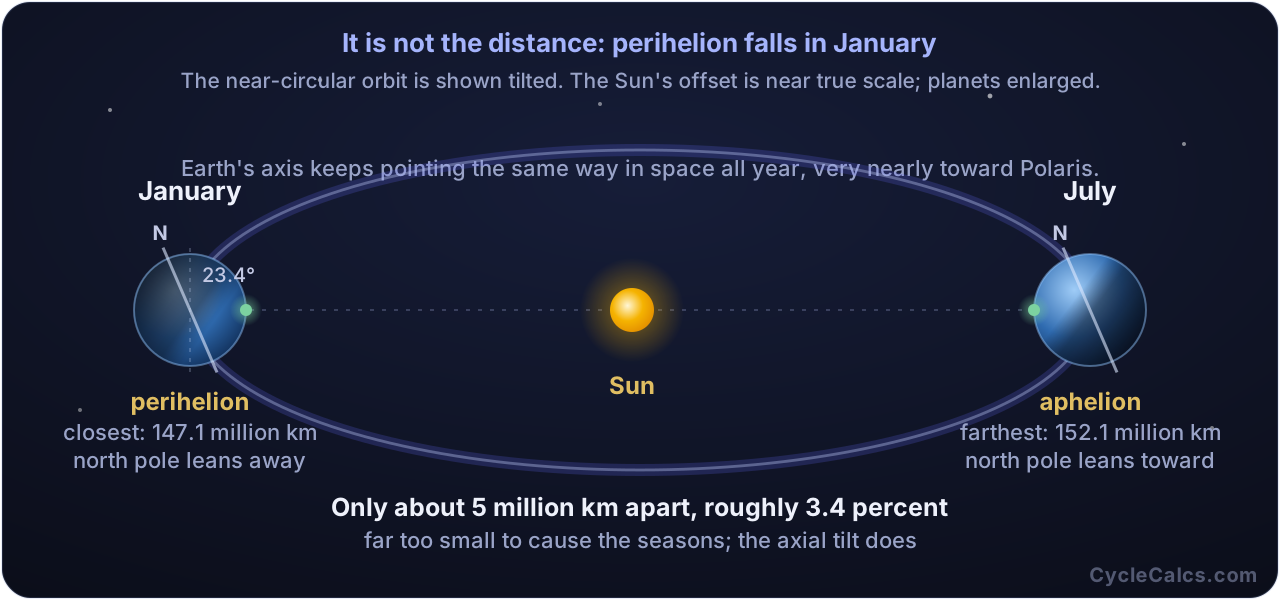
Earth's orbit is not a perfect circle but a slight ellipse, so the planet's distance from the Sun changes through the year. The near point is perihelion, reached in early January, where Earth sits about 147.1 million km from the Sun. The far point is aphelion, reached in early July, at about 152.1 million km. The anomalistic year is the beat of this distance cycle: one full swing from perihelion back to perihelion. Its length, 365.259636 days, comes straight from the USNO and Meeus.
If the orbit held perfectly still against the stars, the anomalistic year and the sidereal year would be identical. They are not, because the ellipse itself turns. The long axis of Earth's orbit, the line through perihelion and aphelion, rotates slowly in the same direction Earth travels, advancing about 11.6 arcseconds a year. Since perihelion keeps moving forward, Earth has to cover a little more than one full orbit to reach it again. That small extra arc is why the anomalistic year is the longest of the three: about 4.7 minutes longer than the sidereal year and about 25 minutes longer than the tropical.
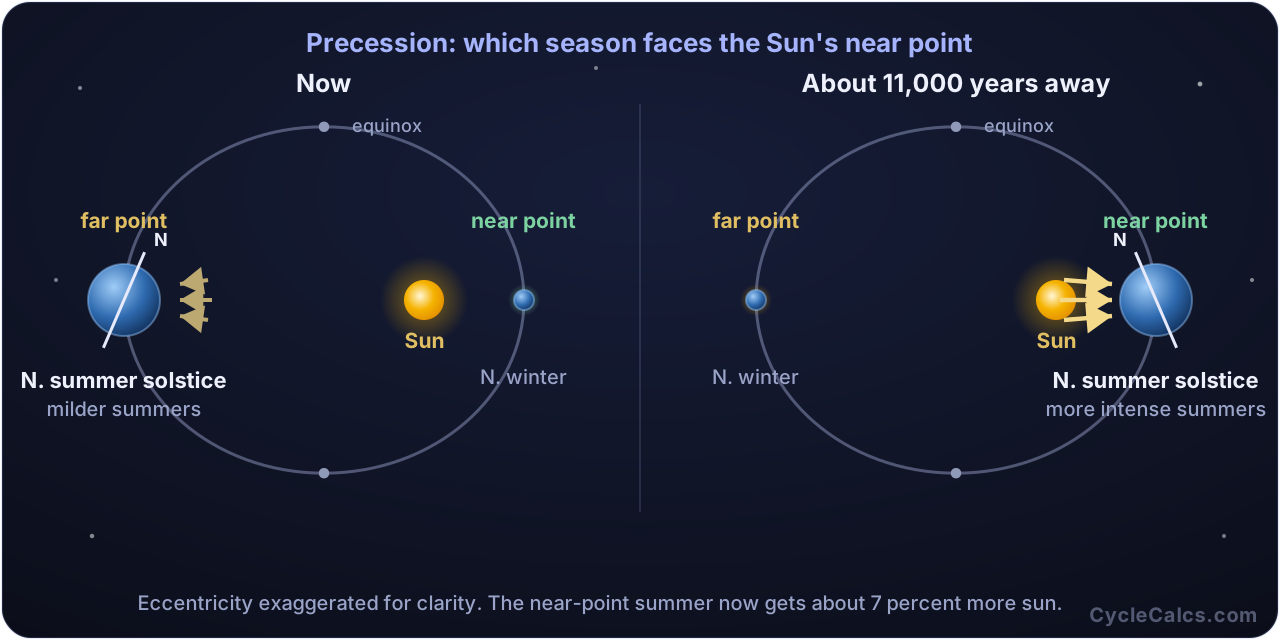
Two different circuits describe how perihelion moves, and they must not be confused. Measured against the fixed stars, perihelion completes one full turn in about 112,000 years. But the equinoxes are also drifting, westward, in the roughly 25,800-year precession of the equinoxes. Because perihelion moves east while the equinox moves west, the two motions close the gap faster: perihelion returns to the same season, and to the same place in the calendar, in about 21,000 years. That shorter figure is the climatic precession the Milankovitch cycles track, and it is a genuinely different quantity from the 112,000-year stellar circuit.
The math
The three year-lengths differ only by how the reference point moves. Start with the sidereal year, 365.256363 days, one orbit against the stars. Add the time needed to catch perihelion's forward creep and the figure grows to the anomalistic year, 365.259636 days; the difference is 0.003273 days, or 4.71 minutes. Account instead for the equinox's backward drift and the figure shrinks to the tropical year, 365.242189 days, which stands 0.017447 days, or 25.1 minutes, below the anomalistic value. The perihelion rate follows directly: a full circle is 1,296,000 arcseconds, and 1,296,000 / 11.6 is about 112,000 years for one turn against the stars.
The climatic period combines the two motions as rates that add. Perihelion advances at about 1/112,000 of a turn per year eastward; the equinox precesses at about 1/25,772 per year westward. Summing the rates, 1/112,000 + 1/25,772, gives roughly 1/21,000 of a turn per year, so perihelion realigns with a given season in about 21,000 years. To see where perihelion and aphelion fall right now, and how far the Sun's distance swings across the year, open the Sun's page.
The next perihelion and aphelion
| Date | Apsis | Sun distance |
|---|---|---|
| Jan 3, 2027 | Perihelion (near) | 147,104,259 km |
| Jul 5, 2027 | Aphelion (far) | 152,100,475 km |
| Jan 5, 2028 | Perihelion (near) | 147,099,818 km |
| Jul 3, 2028 | Aphelion (far) | 152,093,457 km |
| Jan 2, 2029 | Perihelion (near) | 147,098,300 km |
| Jul 6, 2029 | Aphelion (far) | 152,098,351 km |
How the anomalistic year relates to other cycles
The anomalistic year completes a set. The tropical year is the calendar's year, measured equinox to equinox; the sidereal year is the true orbit, measured star to star; the anomalistic year is the distance year, measured perihelion to perihelion. Same orbit, three reference points, three slightly different lengths. The tropical year is shortest, the anomalistic longest, and the sidereal sits between them.
The Moon keeps the same three-way distinction on its own scale. Its distance cycle is the anomalistic month of 27.554550 days, perigee to perigee, the direct lunar analog of this year. For why perihelion in January does not make northern winters warm, see what actually causes the seasons: the axial tilt does that work, not the small change in distance. And for how the slow drift of perihelion through the calendar feeds Earth's ice-age rhythms, see the Milankovitch cycles.
Frequently asked questions
What is the anomalistic year?
The anomalistic year is the time Earth takes to go from perihelion, its closest point to the Sun, back to perihelion again. It lasts 365.259636 days, or 365 days 6 hours 13 minutes 53 seconds. It tracks Earth's distance cycle rather than the seasons or the stars, so it marks when the planet is nearest and farthest from the Sun each year.
Why is the anomalistic year longer than the sidereal year?
Because perihelion is moving. The near point of Earth's orbit advances forward, in the same direction Earth travels, by about 11.6 arcseconds each year. Earth therefore has to travel a little past one full orbit against the stars to reach perihelion again. That extra arc adds about 4.7 minutes, making the anomalistic year 365.259636 days against the sidereal year's 365.256363 days.
Which is the longest year, tropical, sidereal, or anomalistic?
The anomalistic year is the longest at 365.259636 days. The sidereal year, one true orbit against the stars, is 365.256363 days, about 4.7 minutes shorter. The tropical year, measured equinox to equinox, is 365.242189 days, about 25 minutes shorter than the anomalistic year. The differences come from how each year's reference point drifts against the others over time.
How much does Earth's distance from the Sun change over a year?
Earth swings from about 147.1 million km at perihelion in early January to about 152.1 million km at aphelion in early July, a difference of roughly 5 million km, about 3.4 percent. That distance loop, perihelion back to perihelion, is exactly what the anomalistic year of 365.259636 days measures. The change is gradual and smooth, following the shape of Earth's slightly elliptical orbit.
Does the anomalistic year cause the seasons or the ice ages?
No. The seasons come from Earth's axial tilt, not its distance; perihelion falls in early January, during northern winter. But the slow drift of perihelion through the calendar, one season in about 21,000 years, is part of the Milankovitch cycles that pace the ice ages. That climatic precession differs from the 112,000-year circuit perihelion makes against the fixed stars.
When is Earth at perihelion?
Earth next reaches perihelion, its closest approach to the Sun, on January 3, 2027 at about 147,104,259 kilometers. Perihelion comes once per anomalistic year of 365.259636 days, currently in early January. Aphelion, the farthest point, follows about six months later in early July.
Keep exploring
- The sidereal year: one true orbit against the stars
- The tropical year: equinox to equinox, the calendar's year
- The anomalistic month: the Moon's distance cycle, perigee to perigee
- Milankovitch cycles: how orbital drift paces the ice ages
- The Sun: perihelion and aphelion up close