The Callippic cycle
How did ancient astronomers hold the Moon to the calendar for 76 years?
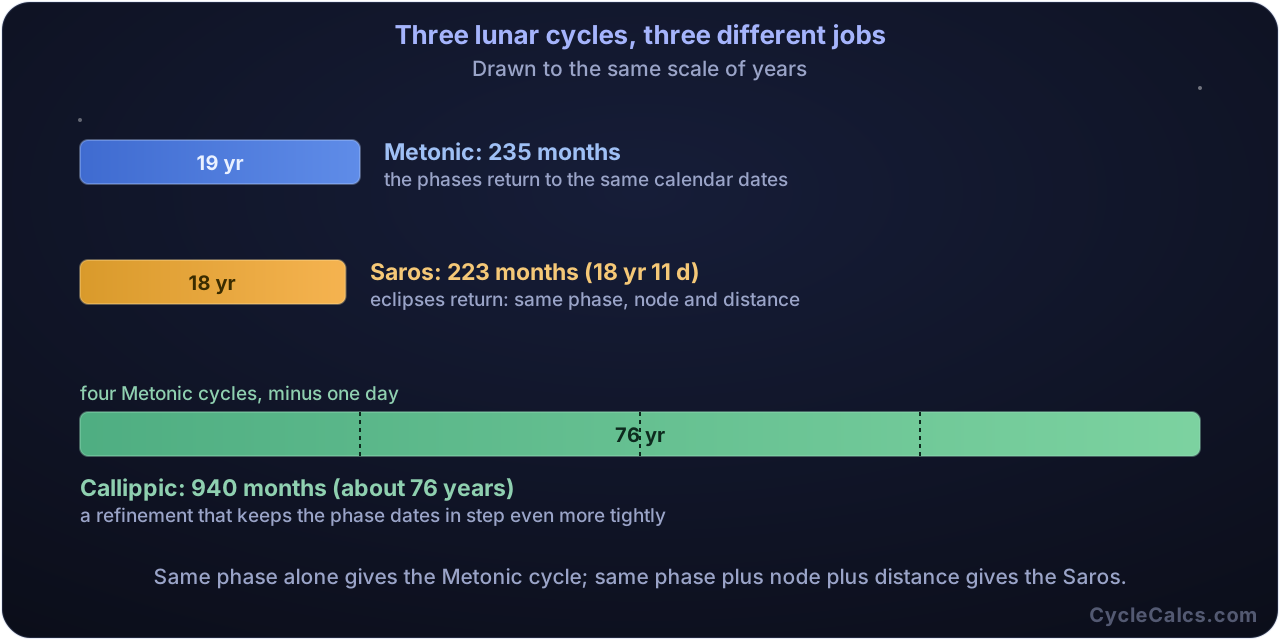
The Callippic cycle runs 27,758.75 days, close to 76 years, and it contains 940 synodic months. It is a refinement of the Metonic cycle: four Metonic spans laid end to end, with a single day struck from the count so that the Moon's phases and the solar calendar stay in step across the longer stretch.
Meton's practical calendar rounded each 19-year cycle to 6,940 whole days, a shade more than the Moon and Sun actually need. Four of those cycles overshoot, so Callippus of Cyzicus dropped one day around 330 BCE, fixing the 76-year calendar at 27,759 days and its mean year at exactly 365.25 days. That one omission is the whole idea, and it holds the phases far steadier than the Metonic cycle does on its own.
How it works, in plain language: The Metonic cycle. This page carries the numbers.
On this page
The Callippic cycle runs 76 years, 940 lunar months, holding the Moon's phases to the calendar far more tightly than a single Metonic cycle can.
The next new moon, on November 9, 2026, has its Callippic echo near November 10, 2102, 76 years on, back to nearly the same phase and date.
Where we are in the Callippic cycle right nowcomputed live
One Callippic cycle from the next new moon (November 9, 2026) lands near November 10, 2102, 76 years later, holding the same phase to within hours. With JavaScript on, this panel shows the current place in the cycle.
Computed live in your browser from the open-source Astronomy Engine. See every cycle together on the cosmic clock.
The Callippic cycle at a glance
| Period | 27,758.75 days (about 76 years) |
|---|---|
| In tropical years | about 76 (27,758.41 days) |
| Synodic months | 940 (27,758.75 days) |
| Equals | 4 Metonic cycles, less 1 day in the calendar |
| Improves on | the Metonic cycle's drift, about 2 h per cycle |
| Mean calendar year | exactly 365.25 days (27,759 / 76) |
| Devised by | Callippus of Cyzicus, about 330 BCE |
| Later refined as | the 304-year Hipparchic cycle |
Sources: U.S. Naval Observatory, Astronomical Information Center.
The Callippic cycle in every unit
The span reads several ways in days, years, and months, and its refinement of the Metonic cycle is one day struck from a whole-day calendar.
| Length in days | 27,758.75 days |
|---|---|
| Length in years | about 76 tropical years |
| 940 synodic months | 940 x 29.530589 d = 27,758.75 d |
| 76 tropical years | 76 x 365.2422 d = 27,758.41 d |
| Moon-Sun gap over the span | 27,758.75 - 27,758.41 = 0.34 d |
| As Metonic cycles | 940 months = 4 x 235 months |
| Callippic calendar | 4 x 6,940 d - 1 d = 27,759 d |
| Mean calendar year | 27,759 / 76 = 365.25 d exactly |
Synodic month 29.530589 days and tropical year 365.2422 days (Meeus, Astronomical Algorithms). The 6,940-day figure is Meton's practical calendar, which rounds the astronomical 6,939.69 days to whole days; Callippus struck one day from four of them, setting the 76-year calendar at 27,759 whole days and its mean month at 27,759 / 940 = 29.53085 days, within about half a minute of the true synodic month.
What the Callippic cycle is and how it arises
The Callippic cycle is a lunisolar calendar period, not a physical orbit. It measures 27,758.75 days, about 76 years, and it holds 940 synodic months. Its parent is the Metonic cycle, the 19-year interval after which the Moon's phases fall on nearly the same calendar dates, marked in old calendars by the golden number. Callippus stacked four Metonic cycles to build a longer and steadier ruler for time.
The correction is a single day. Meton's working calendar counted 6,940 whole days for each 19 years, slightly more than the 6,939.69 days that 235 synodic months truly take and more than the 6,939.60 days of 19 tropical years. Stack four of those calendars and the surplus grows past a full day. Callippus removed one whole day, so the 76-year calendar runs 27,759 days. That sets the mean year at exactly 365.25 days, close to the true 365.2422, and the mean month at 29.53085 days, within about half a minute of the real synodic month.
Callippus of Cyzicus proposed the scheme around 330 BCE. He worked in the tradition of Eudoxus and Aristotle and refined the geometric models of planetary motion then in use, but his calendar carried the longer influence. Hipparchus, two centuries on, dated his observations by Callippic periods so that measurements taken generations apart could be set on one exact time base, and he then tightened the scheme himself into the 304-year Hipparchic cycle, four Callippic periods less one more day.
The math
The relation is two products that nearly agree. Nine hundred forty synodic months come to 940 x 29.530589 = 27,758.75 days. Seventy-six tropical years come to 76 x 365.2422 = 27,758.41 days. The two totals differ by 0.34 day over 76 years, about a third of a day. That gap is four times the Metonic mismatch, since 235 synodic months (6,939.69 days) run 0.09 day ahead of 19 tropical years (6,939.60 days) each cycle.
The calendar handles the gap in whole days. Four Metonic calendars of 6,940 days total 27,760 days; strike one and the Callippic calendar is 27,759 days. Its mean year is 27,759 / 76 = 365.25 days, tighter than Meton's 6,940 / 19 = 365.26 days, and its mean month is 27,759 / 940 = 29.53085 days, within about half a minute of the true synodic month. To watch the phases return across these spans, step through the Moon phase calendar, or compare the family on the cycles catalog.

How the phases repeat after 76 years
| Phase | Next occurrence | Its Callippic echo (76 years on) |
|---|---|---|
| New moon | Nov 9, 2026 | Nov 10, 2102 |
| Full moon | Oct 26, 2026 | Oct 26, 2102 |
How the Callippic cycle relates to other cycles
Read the Callippic cycle as the higher-precision sequel to the Metonic cycle. Both belong to the lunisolar family, the calendars that reconcile the Moon's phases with the seasons. The Metonic cycle does this over 19 years and returns the phases to the same dates; the Callippic cycle stretches to 76 years and, by dropping a day, keeps them there far longer. For the golden number and the Easter computus worked through step by step, see the Metonic cycle lesson.
The period is built from two simpler cycles profiled here: the synodic month supplies its 940 lunar months, and the tropical year supplies its 76 seasonal years. It is worth setting beside the Saros, another long lunar period but a different kind: the Saros brings whole eclipses back to nearly the same geometry, while the Callippic cycle keeps a calendar aligned. Same lunar raw material, different quantity conserved.
Frequently asked questions
How long is the Callippic cycle?
The Callippic cycle is 27,758.75 days, about 76 years. That length is 940 synodic months, since 940 times the 29.530589-day synodic month gives 27,758.75 days. Seventy-six tropical years measure 27,758.41 days, so the lunar and solar totals agree to about a third of a day over the whole span. As a calendar it was fixed at 27,759 whole days.
What is the difference between the Metonic and Callippic cycles?
The Metonic cycle is 19 years, or 235 synodic months, after which the Moon's phases fall on nearly the same calendar dates. The Callippic cycle is four Metonic cycles, 76 years and 940 synodic months, with one day removed from the calendar count. That single omission corrects most of the Metonic cycle's slow drift, so the phases and the seasons stay aligned over a much longer span.
Why does the Callippic cycle drop one day?
Meton's practical calendar rounded each 19 years to 6,940 whole days, slightly more than the Moon and Sun actually need. Four of those calendars run to 27,760 days and overshoot by more than a day. Callippus removed one whole day to make the 76-year calendar 27,759 days. That sets the mean year at exactly 365.25 days and the mean month within about half a minute of the true synodic month.
Who invented the Callippic cycle?
Callippus of Cyzicus devised it around 330 BCE. He worked in the tradition of Eudoxus and Aristotle and refined the geometric models of planetary motion then in use. His 76-year cycle improved on the Metonic cycle as a calendar and as a timekeeping standard. Hipparchus later dated observations by Callippic periods, which let astronomers compare measurements taken generations apart against one precise time base.
What is the Hipparchic cycle?
The Hipparchic cycle is 304 years, four Callippic cycles with one more day removed. Hipparchus introduced it to squeeze out the small residual error that the Callippic cycle still carries. Where the Callippic cycle sets the mean year at 365.25 days, the Hipparchic refinement pulls it closer to the true 365.2422-day tropical year, at the cost of a much longer and less practical calendar span.
Keep exploring
- The Metonic Cycle: the 19-year cycle it refines
- Learn: The Metonic Cycle: golden numbers and Easter worked through
- The Saros: a long lunar cycle for eclipses, not calendars
- The Tropical Year: the 76 seasonal years inside it
- The Synodic Month: the 940 months inside it