The December solstice
On this page
- Next solstice
- December 21, 2026, 20:50 UTC
- What begins
- Winter begins astronomically in the Northern Hemisphere and summer in the Southern
- Possible dates
- December 20 to 23 (UTC)
- Sun overhead at
- The Tropic of Capricorn, 23.4 degrees south
- Sun's declination
- About 23.4 degrees south of the celestial equator
The December solstice is the instant the Sun's center reaches its farthest point south of the celestial equator, ecliptic longitude 270 degrees. For the Northern Hemisphere it brings the shortest day and the longest night of the year; south of the equator the same instant is the longest day. It is one moment, shared by the whole planet: only your clock's reading of it differs.
Your day, computed
Enter a location (or use your device's) and we compute your sunrise, sunset and day length for the December solstice, plus the dates when your sunrise and sunset hit their yearly extremes around it (which pair depends on your hemisphere), all in your browser.
No location set yet.
Exact solstice instants, 2026 to 2032
Computed with the same open-source ephemeris that runs every live tool on this site; instants are stated to the minute and reliable to about a minute. Your time zone can shift a calendar date by a day either way.
| Year | Date & time |
|---|---|
| 2026 | December 21, 2026, 20:50 UTC |
| 2027 | December 22, 2027, 02:42 UTC |
| 2028 | December 21, 2028, 08:20 UTC |
| 2029 | December 21, 2029, 14:14 UTC |
| 2030 | December 21, 2030, 20:10 UTC |
| 2031 | December 22, 2031, 01:56 UTC |
| 2032 | December 21, 2032, 07:56 UTC |
Times shown in your local time zone.
An instant, not a day
The word solstice comes from the Latin sol (Sun) and sistere (to stand still). Through December the Sun's noon height and its rise and set points along the horizon change more slowly each day, stall at the solstice, then begin creeping back, the way a thrown ball hangs at the top of its arc. Nothing stops; a rate reaches zero. The stall is why ancient observers could bracket the solstice within a few days but needed monuments and generations of patience to pin it down, and why the engine behind this page can state it to the minute.
The earliest sunset is not on the shortest day
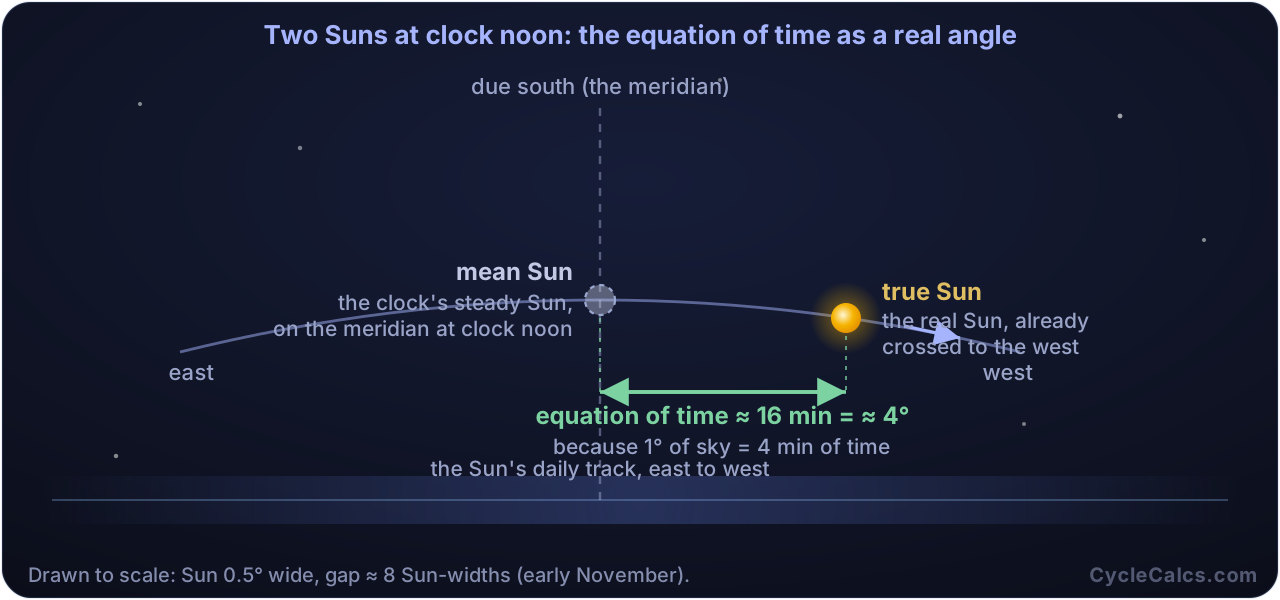
At mid-northern latitudes the earliest sunset of the year comes about two weeks before the December solstice, and the latest sunrise about two weeks after, in early January. The shortest day sits between them. The culprit is the equation of time: through this stretch of the year each true solar day runs up to about half a minute longer than 24 clock hours, so solar noon, and sunrise and sunset with it, drifts steadily later on the clock. Before the solstice that drift outruns the shrinking afternoon, so sunset bottoms out early; after it, the drift outruns the slowly growing morning, so sunrises keep getting later into January. This is also why mornings stay dark after the solstice while the afternoons visibly lengthen. The size of the offset depends on your latitude, which is what the panel above computes; the full mechanism, with the analemma it draws in the sky, lives in our Equation of Time lesson.
Why the date drifts between December 20 and 23
The year of the seasons, the tropical year, runs about 365.2422 days. Each common year the solstice therefore lands about 5 hours 49 minutes later on the clock than the year before; each leap day then yanks it back about 18 hours. The four-year sawtooth slides slowly earlier across a century until a skipped century leap year resets it. The extremes are genuinely rare: the last December 23 solstice (UTC) came in 1903 and the next arrives in 2303, while the next December 20 solstice comes in 2080. Our tropical year profile takes the calendar arithmetic apart in full.
Day length from the equator to the poles
How short the shortest day is depends entirely on latitude. Near the equator daylight barely changes all year. Around latitude 40 the December solstice day runs a bit over 9 hours; around latitude 60, closer to 6. Poleward of the polar circles, near 66.5 degrees, the Sun can stay down for a full 24 hours or more, and at the North Pole polar night runs about 179 days. Two mercies soften the geometry: atmospheric refraction lifts the Sun's image about half a degree at the horizon, and rise and set are reckoned from the Sun's upper edge, so daylight everywhere is a little longer than the bare geometry suggests. Right at the geometric circle, in fact, those two effects all but erase polar night; true 24-hour darkness begins noticeably poleward of the line on the map. After the solstice the light returns slowly at first, seconds per day, reaching a minute or so per day by early January at mid-latitudes and two to three minutes per day by late February.
Not the coldest day, and not about distance
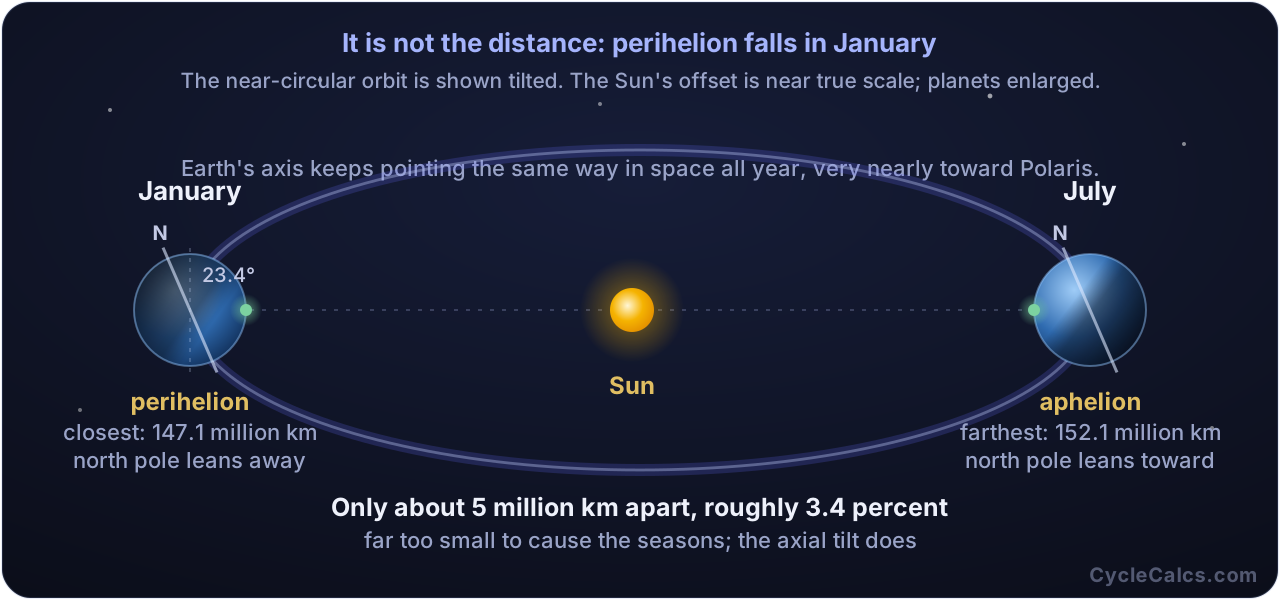
The solstice is the trough of sunlight, not of temperature. For weeks afterward the Northern Hemisphere still loses more heat each day than it gains, so the coldest average temperatures arrive in January or February, a delay called seasonal lag; oceans stretch it, continental interiors shorten it. And distance has nothing to do with it: Earth actually passes closest to the Sun, perihelion, in early January, about two weeks after this solstice. The seasons come from the 23.4 degree tilt of Earth's axis, not from the 3 percent breathing of its orbit. That small distance swing does hand the Southern Hemisphere about 7 percent stronger midsummer sunshine, but southern summers are not dramatically hotter: the south is mostly ocean, and water soaks up the difference. The whole geometry is drawn out in our Seasons lesson, and the Live Orrery steps through it with real dates in why we have seasons.
Midwinter in stone and firelight
The December solstice is the best-documented astronomical event in prehistoric architecture. Newgrange in Ireland, built around 3200 BC, carries a purpose-built opening above its entrance, the roof-box, that admits a beam of sunrise light down the 19-meter passage into the central chamber for about 17 minutes on the mornings around the solstice; the alignment was confirmed at the 1967 solstice during Michael O'Kelly's excavations. Stonehenge's great sarsens, raised about 2500 BC, stand on a single solstitial axis, and although the summer crowds are the modern tradition, the archaeology increasingly points the other way: pig bones from feasts at nearby Durrington Walls come mostly from animals about nine months old, spring-born and midwinter-killed, so the December sunset between the uprights of the tallest trilithon may have been the main event.
The festivals carried the moment into the calendar. Yule, the pre-Christian Germanic midwinter feast, left its name on Christmas across Scandinavia (jul today); its original dates are unrecorded, and one leading scholarly argument places it at the first full moon after the first new moon following the solstice, a hypothesis rather than a consensus. In China, Dongzhi, "winter's extreme", has roots in the Zhou era and became an official holiday under the Han dynasty; families gather and, especially in the south, eat tangyuan, glutinous rice balls whose roundness stands for reunion. And the old argument about whether this is the first day of winter or midwinter is really two calendars talking past each other: meteorologists start winter on December 1, astronomical calendars start it at the solstice, and older reckonings that put the solstice at winter's middle survive in words like midsummer. All are conventions; the instant is the astronomy.
Frequently asked questions
Is the December solstice a whole day or a single moment?
A single moment: the instant the Sun's center reaches its greatest distance south of the celestial equator, about 23.4 degrees. Everyone on Earth shares that instant; only the local clock reading differs, which is why the same solstice can be December 21 in New York and December 22 in Sydney.
Why does the earliest sunset come before the shortest day?
Because true solar days near the solstice run up to about half a minute longer than 24 hours, solar noon drifts later on the clock through December. Sunset reaches its earliest a couple of weeks before the solstice and sunrise its latest a couple of weeks after, with the shortest day in between. The panel on this page computes the dates for your own latitude.
Is the December solstice always on December 21?
No. In Universal Time it can fall anywhere from December 20 to 23, driven by the leap-year cycle: each common year it lands about 5 hours 49 minutes later, and each leap day pulls it back about 18 hours. December 23 solstices are rare (last 1903, next 2303); the next December 20 solstice comes in 2080.
Is the December solstice the coldest day of the year?
Almost never. The solstice is the minimum of sunlight, but land and oceans keep losing more heat than they gain for weeks afterward, so the coldest averages arrive in January or February. The delay is called seasonal lag.
Does the December solstice mean Earth is farthest from the Sun?
No, nearly the opposite: Earth reaches perihelion, its closest point to the Sun, in early January, about two weeks after the December solstice. The seasons come from Earth's 23.4 degree axial tilt, not from distance.
Keep exploring: why the tilt makes the seasons, the tropical year our calendar tracks and the slow axial precession that carries the equinox westward against the stars over millennia, sunrise and sunset for any date, and The Sun with every equinox and solstice for two years.
The other three turning points
One tilted axis produces all four instants. Each page computes its own exact times and your local day length.
March Equinox
Falls March 19 to 21 (UTC), when spring begins astronomically in the Northern Hemisphere and autumn in the Southern.
June Solstice
Falls June 20 to 22 (UTC), when summer begins astronomically in the Northern Hemisphere and winter in the Southern.
September Equinox
Falls September 21 to 24 (UTC), when autumn begins astronomically in the Northern Hemisphere and spring in the Southern.
Earth: the tilt behind all four
The 23.4 degree axial tilt that produces every equinox and solstice, with Earth's day, year, perihelion and aphelion.