Earth
Earth is the third planet from the Sun, a rocky world 12,756 kilometers across, and the only place we know of where water sits liquid on the surface under a breathable sky. It carries a single large Moon, an atmosphere of roughly 78 percent nitrogen and 21 percent oxygen, and a magnetic field generated in its molten iron core that deflects much of the solar wind. Together they make it a world where an observer can stand on solid ground and keep time by the sky overhead.
This page is different from the others on the site. You do not go out and find Earth in the sky, because you are standing on it. What matters here is motion. Earth spins, Earth orbits, and Earth's axis leans over at a fixed angle. Those three facts set nearly every clock the rest of this site reads, from the length of a day to the roughly 25,800-year wobble of the pole. Understand how Earth moves and you understand where the cycles come from.
On this page
Earth is tilted 23.44 degrees on its axis, so the northern and southern hemispheres trade seasons through the year. The next equinox or solstice is the turning point where the tilt hands the long days from one hemisphere to the other.
The tilt and the shape of the year are worked out in the sections below; the cosmic clock shows where Earth stands in the day, the month and the year right now.
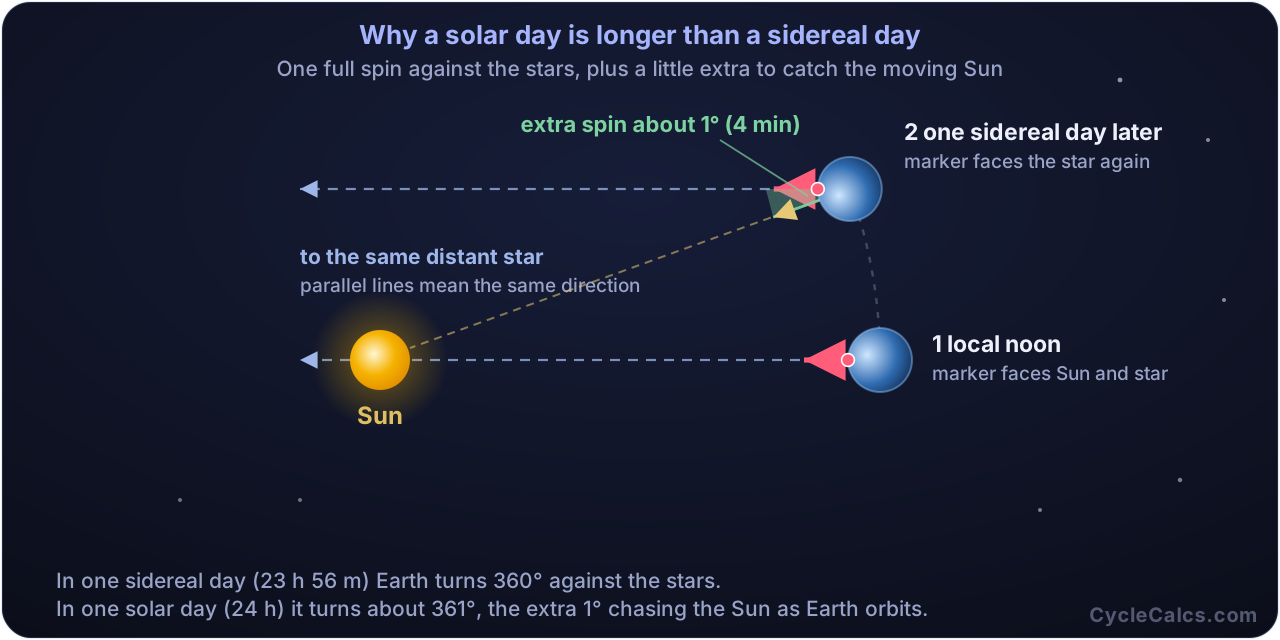
A day on Earth is 24 hours by the Sun, but Earth turns once in 23 hours 56 minutes against the stars. The four-minute gap is the difference between a solar and a sidereal day, worked out in full under The day below.
Earth at a glance
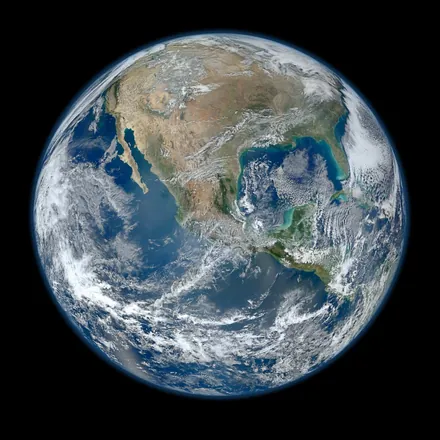
| Position | Third planet from the Sun |
|---|---|
| Equatorial diameter | 12,756 km (polar 12,714 km) |
| Mean radius | 6,371 km |
| Mass | 5.97 x 10^24 kg |
| Mean density | 5,514 kg/m^3 (densest planet) |
| Surface gravity | 9.80 m/s^2 |
| Escape velocity | 11.19 km/s |
| Sidereal rotation | 23.934 hours (23 h 56 m 4 s) |
| Solar day | 24.000 hours |
| Mean distance from Sun | 149.6 million km (1 AU) |
| Orbital eccentricity | 0.0167 (nearly circular) |
| Sidereal orbital period | 365.256 days |
| Tropical year | 365.242 days |
| Mean orbital velocity | 29.78 km/s |
| Axial tilt (obliquity) | 23.44 degrees |
| Moons | 1 (unusually large) |
| Mean surface temperature | about 15 C (288 K) |
Physical data: NASA NSSDCA Earth Fact Sheet.
The day: one turn of Earth
A day is one rotation of Earth, but there are two honest ways to measure it, and they disagree by about four minutes. The sidereal day, one full turn measured against the fixed stars, is 23 hours 56 minutes 4 seconds. The solar day, one turn measured against the Sun, is the familiar 24 hours. The difference is not an error. While Earth spins once, it also travels a little way along its orbit, so it has to turn a bit further, close to one extra degree, before the Sun returns to the same spot in the sky. That extra turn is the missing four minutes.
You feel the solar day because your life runs on the Sun. Sunrise, noon, and sunset are all solar events, which is why our clocks keep the 24-hour figure. The star-based day quietly wins over a year: the stars rise about four minutes earlier each night, which is why the constellations march through the seasons. If you want the two definitions worked out in full, the page on the sidereal versus solar day lays it out, and the sunrise and sunset calculator turns the solar day into rise, set, and daylength for any date and place.
The year and the shape of the orbit
A year is one trip around the Sun, and here too there are two figures. The sidereal year, one orbit measured against the stars, is 365.256 days. The tropical year, measured from one spring equinox to the next, is 365.242 days, and it is the one the calendar keeps because it tracks the seasons. The two differ by about 20 minutes, and the reason is precession, which comes later on this page. The sidereal year is the truer measure of Earth's orbit against the stellar background.
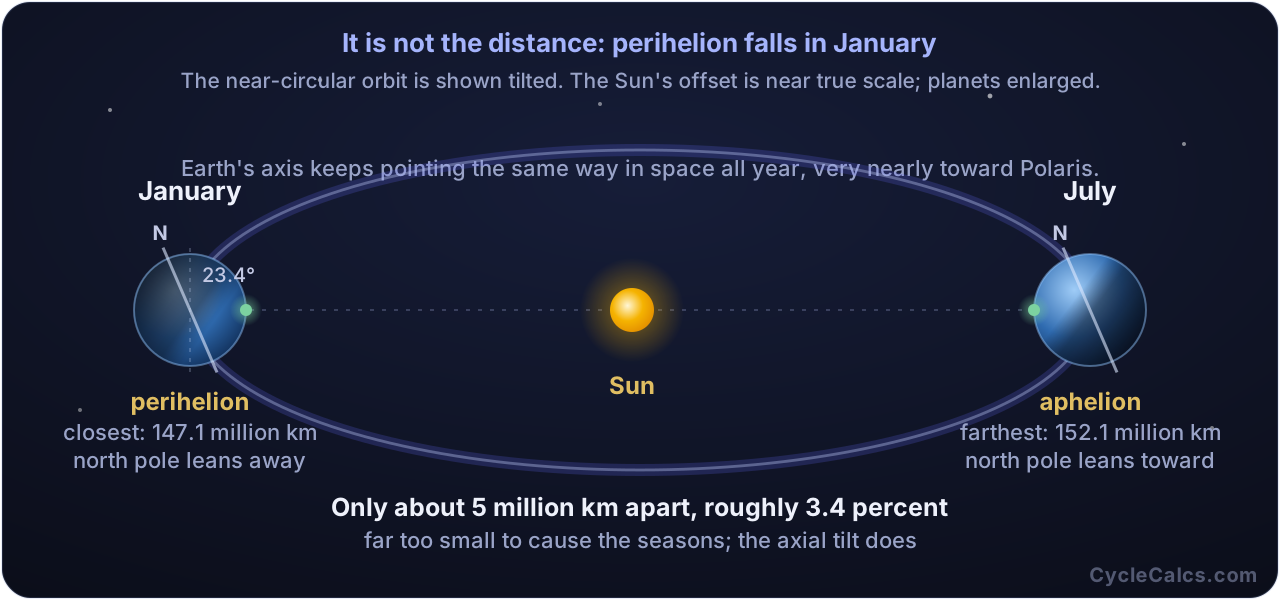
The orbit itself is very nearly a circle. Its eccentricity is 0.0167, so the path bulges only slightly. Earth is closest to the Sun, at perihelion, in early January, about 147.1 million kilometers away; it is farthest, at aphelion, in early July, about 152.1 million kilometers away. The mean distance, 149.6 million kilometers, defines the astronomical unit, and light crosses it in about 8.3 minutes. That January perihelion catches people out. The planet is nearest the Sun in the depth of northern winter and farthest in the northern summer, so distance is not what makes the seasons. That is the work of the tilt. You can see where Earth sits along this year right now on the cosmic position page.
The tilt and the seasons
Earth's axis is tilted 23.44 degrees from the perpendicular to its orbit, and that lean, called the obliquity, is the whole cause of the seasons. As Earth circles the Sun the axis keeps pointing the same way in space, so for half the year the northern hemisphere tips toward the Sun and for the other half it tips away. When your hemisphere leans sunward the Sun climbs higher, the days grow long, and its light strikes the ground more directly. That is summer. The small change in Earth-Sun distance across the year is real but minor, and in the north it runs the opposite way, warming least when the planet is closest.
The turning points have names. At the solstices in June and December the axis is tilted most fully toward or away from the Sun, giving the longest and shortest days. At the equinoxes in March and September the axis leans neither way, and day and night run close to equal worldwide. Across the year the tilt swings the Sun's declination, its angular height relative to the celestial equator, from plus 23.44 degrees to minus 23.44 degrees and back. The page on the seasons shows the geometry, and the equation of time explains why, thanks to tilt and orbit together, a sundial and a clock disagree through the year.
The Moon and the tides
Earth has one moon, and it is an oddly large one, a quarter of Earth's diameter, far bigger relative to its planet than any other moon of a planet in the solar system. Its gravity pulls harder on the near side of Earth than on the far side, and that difference stretches the oceans into two bulges, one under the Moon and one opposite. As Earth rotates beneath those bulges, most coasts pass through two high tides and two low tides a day. The Sun adds a weaker pull of its own, and when Sun and Moon line up at new and full moon the tides run to their largest, the spring tides.
The Moon does more than raise water. Its steady gravitational grip acts as a stabilizer on Earth's spin axis, holding the 23.44-degree tilt to small variations over long spans of time. A world without so large a moon could see its obliquity wander much more widely, with a harsher climate to match. For the full picture, see the Moon itself, the mechanics of the tides, why the Moon keeps one face turned toward us in tidal locking, and the changing shapes in moon phases.
The slow wobble: precession
Earth's axis does not point in a fixed direction forever. Like a spinning top leaning under gravity, the axis traces a slow cone in the sky, one full circuit in about 25,800 years. This is axial precession, driven by the Sun and Moon tugging on Earth's equatorial bulge. Over that long turn the celestial pole drifts among the stars. Polaris is our pole star now, but it has not always held the post and will not always hold it; thousands of years from now the axis will point elsewhere, and other stars will take the northern seat in turn.
Precession is also the quiet reason the two years differ. Because the axis creeps westward, the equinox point slides a little around the orbit each year, so Earth reaches the spring equinox slightly before it completes a full circuit against the stars. That head start makes the tropical year about 20 minutes shorter than the sidereal year. The mechanism is drawn out on the precession page, and the cycle itself is cataloged under axial precession.
Earth's place in the solar system
Earth is the third planet out, orbiting at 1 astronomical unit, where sunlight arrives after about 8.3 minutes; the Sun you watch set has in a sense already set eight minutes earlier. It moves along that orbit at a mean speed of 29.78 kilometers per second, fast enough to cross its own diameter in about seven minutes. Earth sits in the temperate middle ground of the solar system, in the range of temperatures where water stays liquid, with a mean surface temperature near 15 degrees Celsius. That range is held less by distance alone than by the atmosphere, which traps enough heat to keep the surface mild.
Earth masses 5.97 times ten to the twenty-fourth kilograms, pulls with a surface gravity of 9.80 meters per second squared, and holds so tightly that escaping it outright takes 11.19 kilometers per second. It is very slightly oblate, 12,756 kilometers across the equator against 12,714 kilometers pole to pole, because the spin flings the equator outward. The star it circles gets its own treatment on the Sun page, and Earth's shadow, cast out into space, produces the lunar eclipses covered under eclipses and mapped in the eclipse explorer.
How Earth sets the clocks
Put the motions together and the site's whole catalog of cycles falls out of one planet. The day comes from rotation. The month comes from the Moon going around us. The year and the seasons come from the orbit and the 23.44-degree tilt working together. The long, slow cycles, precession chief among them, come from the axis itself turning over across about 25,800 years. Every calculator here is, at bottom, reading one of these Earth motions.
That is why Earth is the keystone. To see all the readings at once, the cosmic position page shows where Earth stands in the day, the month, the year, and the great slow turn right now, and the cycles reference gathers the full set with the numbers and the physics behind each one.
Frequently asked questions
Why is Earth closest to the Sun in winter?
Earth reaches perihelion, its closest point to the Sun at about 147.1 million kilometers, in early January, which is the depth of northern winter. The seasons are set by Earth's 23.44 degree axial tilt, not by its distance from the Sun. The orbit is so nearly circular, with an eccentricity of only 0.0167, that the small change in distance has little effect on temperature. When the northern hemisphere leans away from the Sun it is winter there, regardless of the slightly shorter distance.
Why is a day 24 hours if Earth spins in 23 hours 56 minutes?
Earth turns once against the stars in 23 hours 56 minutes 4 seconds, which is called the sidereal day. But while it spins, Earth also moves along its orbit, so it has to turn nearly one extra degree before the Sun returns to the same place in the sky. That extra bit of rotation takes about four minutes and brings the solar day to a full 24 hours. Our clocks keep the solar day because daily life runs on the Sun.
What causes the seasons?
The seasons come from Earth's axial tilt of 23.44 degrees, not from any change in distance to the Sun. As Earth orbits, each hemisphere spends half the year leaning toward the Sun and half leaning away. When your hemisphere tips sunward the Sun climbs higher and the days grow longer, which is summer; when it tips away you get winter. Earth is actually closest to the Sun during northern winter, which shows that distance is not the driver.
How big is Earth?
Earth is 12,756 kilometers across at the equator and 12,714 kilometers from pole to pole, giving a mean radius of 6,371 kilometers. It is very slightly wider around the middle because its rotation flings the equator outward, a shape called an oblate spheroid. Its mass is 5.97 x 10^24 kilograms, and at 5,514 kilograms per cubic meter it is the densest planet in the solar system.
How fast does Earth move?
Earth travels around the Sun at a mean orbital speed of 29.78 kilometers per second, close to 107,000 kilometers per hour. On top of that it spins on its axis, carrying a point on the equator around at roughly 0.46 kilometers per second. You feel none of this motion because it is steady and everything around you moves with you.
Does Earth's axis really move?
Yes. Earth's spin axis slowly traces a cone in the sky, completing one full circuit in about 25,800 years, a motion called precession. Over that long turn the pole star changes; Polaris marks the north celestial pole today but has not always done so and will not always do so. This same slow drift is why the tropical year is about 20 minutes shorter than the sidereal year.
Keep exploring
- Cosmic position: Where Earth stands in the day, month, and year right now, all the clocks on one dial.
- Cycles reference: The full catalog of astronomical cycles, most of them born from Earth's own motions.
- The Moon: Our unusually large moon, the source of the tides and the steadier of Earth's tilt.
- The Sun: The star Earth orbits, and the reference point for the solar day and the tropical year.
- Precession: The roughly 25,800-year wobble of Earth's axis and why it splits the two kinds of year.
Cite this page
CycleCalcs, "Earth: Our Home Planet, Tilt, Orbit and Cycles", CycleCalcs LLC, https://www.cyclecalcs.com/the-earth.html (add your access date). The underlying event datasets are archived with a permanent DOI: 10.5281/zenodo.21905241, which always resolves to the newest version. Since v1.1.0 that archived record also carries the engine's accuracy study against JPL Horizons, with every raw residual and the code that reproduces it; the same files are browsable in the data repository.
Every computed value on this page is public domain: CycleCalcs asserts no copyright in calculated astronomical facts and dedicates any such right to CC0, stated here. Quote the numbers freely, with or without credit. Conventions and sources: the engine and sources.