The June solstice
On this page
- Next solstice
- June 21, 2027, 14:11 UTC
- What begins
- Summer begins astronomically in the Northern Hemisphere and winter in the Southern
- Possible dates
- June 20 to 22 (UTC)
- Sun overhead at
- The Tropic of Cancer, 23.4 degrees north
- Sun's declination
- About 23.4 degrees north of the celestial equator
The June solstice is the instant the Sun's center reaches its farthest point north of the celestial equator, ecliptic longitude 90 degrees. For the Northern Hemisphere it is the longest day of the year; south of the equator, the shortest. One instant, the whole planet, different clocks.
Your day, computed
Enter a location (or use your device's) and we compute your sunrise, sunset and day length for the June solstice, plus the dates when your sunrise and sunset hit their yearly extremes around it (which pair depends on your hemisphere), all in your browser.
No location set yet.
Exact solstice instants, 2026 to 2032
Computed with the same open-source ephemeris that runs every live tool on this site; instants are stated to the minute and reliable to about a minute. Your time zone can shift a calendar date by a day either way.
| Year | Date & time |
|---|---|
| 2026 | June 21, 2026, 08:25 UTC |
| 2027 | June 21, 2027, 14:11 UTC |
| 2028 | June 20, 2028, 20:02 UTC |
| 2029 | June 21, 2029, 01:49 UTC |
| 2030 | June 21, 2030, 07:31 UTC |
| 2031 | June 21, 2031, 13:17 UTC |
| 2032 | June 20, 2032, 19:09 UTC |
Times shown in your local time zone.
An instant, not a day
Solstice is Latin for "the Sun stands still". Through June the Sun's noon height and its rise and set points along the horizon change less each day, pause at the solstice, and then begin the slow retreat south. Nothing halts; a rate passes through zero, like a ball hanging at the top of its arc. The stall is also why the days around the solstice feel interchangeable: within a week of it, day length changes by barely a minute at mid-latitudes.
The earliest sunrise is not on the longest day
The December solstice's famous quirk runs in mirror image here: at mid-northern latitudes the earliest sunrise of the year comes days before the June solstice, and the latest sunset days after it, with the longest day between them. The cause is the same equation of time, the slow seasonal drift of solar noon against the clock; in June the offset is smaller than in December but still enough to notice in a sunrise diary. The panel above computes your own dates; the full mechanism lives in our Equation of Time lesson.
Why the date drifts between June 20 and 22
The tropical year runs about 365.2422 days, so each common year the solstice lands about 5 hours 49 minutes later than the year before, and each leap day pulls it back about 18 hours. That sawtooth slides the solstice slowly earlier through each century: June 20 solstices, once rare, are now routine in leap years. The extremes are still uncommon: the last June 22 solstice (UTC) came in 1975 and the next is not due until 2203. The calendar arithmetic gets its full treatment in our tropical year profile.
Day length from the equator to the midnight sun
Around latitude 40 the June solstice day runs about 15 hours; around latitude 60, nearly 19. Poleward of about 66.5 degrees the Sun does not set at all: the midnight sun. The spectacle gets a bonus from the same pair of effects that stretch daylight everywhere: refraction lifts the Sun's image about half a degree, and rise and set are reckoned from the Sun's upper edge, so the midnight sun is actually visible from roughly 65 degrees 44 minutes north, slightly outside the polar circle, and polar day everywhere outlasts polar night. South of the equator all of this runs in reverse: this is the Southern Hemisphere's shortest day, and Antarctic stations sit in the middle of their long night.
Not the hottest day, and not about distance
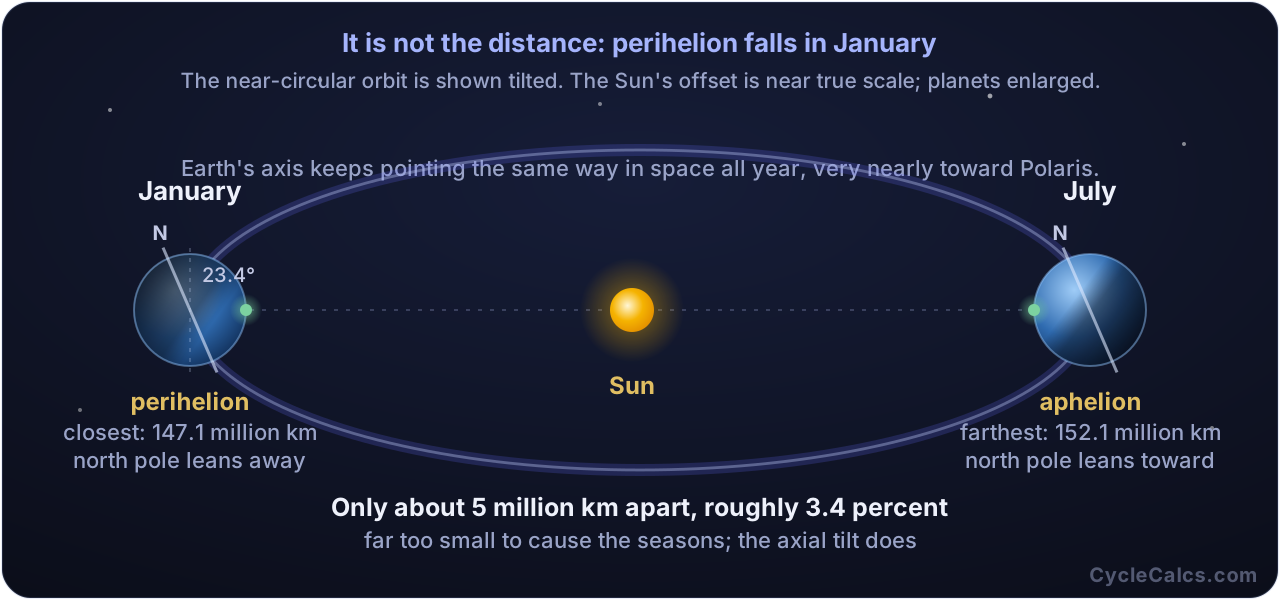
Peak sunlight is not peak heat. For weeks after the June solstice the Northern Hemisphere still gains more heat each day than it loses, so the hottest averages arrive in July or August, the seasonal lag that oceans stretch and continental interiors shorten. Distance plays no part: Earth is actually near its farthest from the Sun, aphelion, in early July, right after this solstice. Seasons come from the 23.4 degree tilt, as our Seasons lesson draws out; the orbit's 3 percent distance swing only fine-tunes them.
Midsummer fires and a mountain new year
In the Andes the June solstice is southern midwinter, and it anchored the Inca new year. Inti Raymi, the festival of the sun god Inti, is attributed by the chronicler Garcilaso de la Vega to the emperor Pachacuti; the last imperial ceremony was held in 1535 before Spanish suppression, and the modern reconstruction, staged by Faustino Espinoza Navarro in Cusco in 1944, now fills Sacsayhuaman every June 24. In Scandinavia the same solstice is the year's bright pole: Midsummer, the great bonfire-and-maypole festival, was folded by the church into St John's Day on June 24, which is why the celebrations land a few days after the astronomical instant. Stonehenge's solstitial axis points here too: at the June solstice the Sun rises just left of the Heel Stone into the monument's heart, the alignment that draws the modern crowds, though the archaeology of feasting at nearby Durrington Walls suggests the December sunset may have been the builders' main event.
Frequently asked questions
Is the June solstice a whole day or a single moment?
A single moment: the instant the Sun's center reaches its greatest distance north of the celestial equator, about 23.4 degrees. The whole planet shares the instant; time zones just read it differently, so it can be June 20 in Los Angeles and June 21 in London.
Why does the earliest sunrise come before the longest day?
The equation of time drifts solar noon later on the clock through this stretch of the year, so sunrise bottoms out days before the solstice and sunset peaks days after it, with the longest day in between. The panel on this page computes your own dates.
Is the June solstice always on June 21?
No. In Universal Time it ranges from June 20 to 22 with the leap-year sawtooth: about 5 hours 49 minutes later each common year, then about 18 hours back at each leap day. June 22 solstices are rare (last 1975, next 2203), while June 20 now recurs in leap years.
Where is the midnight sun visible at the June solstice?
Everywhere poleward of about 65 degrees 44 minutes north. The geometric line is the Arctic Circle near 66.5 degrees, but atmospheric refraction lifts the Sun's image about half a degree and rise and set are reckoned from the Sun's upper edge, together extending the midnight sun visibly south of the circle.
Is Earth closest to the Sun at the June solstice?
No, it is close to farthest. Aphelion, Earth's most distant point from the Sun, falls in early July. The seasons are made by Earth's 23.4 degree axial tilt, not by distance.
Keep exploring: why the tilt makes the seasons, the tropical year our calendar tracks and the slow axial precession that carries the equinox westward against the stars over millennia, sunrise and sunset for any date, and The Sun with every equinox and solstice for two years.
The other three turning points
One tilted axis produces all four instants. Each page computes its own exact times and your local day length.
September Equinox
Falls September 21 to 24 (UTC), when autumn begins astronomically in the Northern Hemisphere and spring in the Southern.
December Solstice
Falls December 20 to 23 (UTC), when winter begins astronomically in the Northern Hemisphere and summer in the Southern.
March Equinox
Falls March 19 to 21 (UTC), when spring begins astronomically in the Northern Hemisphere and autumn in the Southern.
Earth: the tilt behind all four
The 23.4 degree axial tilt that produces every equinox and solstice, with Earth's day, year, perihelion and aphelion.