The March equinox
On this page
- Next equinox
- March 20, 2027, 20:25 UTC
- What begins
- Spring begins astronomically in the Northern Hemisphere and autumn in the Southern
- Possible dates
- March 19 to 21 (UTC)
- Sun overhead at
- The equator itself
- Sun's declination
- Zero: the Sun crosses the celestial equator heading north
The March equinox is the instant the Sun's center crosses the celestial equator heading north, apparent ecliptic longitude exactly 0 degrees. The subsolar point stands on the equator, the terminator runs through both poles, and both hemispheres are lit alike. It is also the zero point of the sky's coordinates: every zodiac position on this site is measured from this moment's place among the stars.
Your day, computed
Enter a location (or use your device's) and we compute your sunrise, sunset and day length for the March equinox, plus your own equilux date, when day and night come closest to equal, all in your browser.
No location set yet.
Exact equinox instants, 2026 to 2032
Computed with the same open-source ephemeris that runs every live tool on this site; instants are stated to the minute and reliable to about a minute. Your time zone can shift a calendar date by a day either way.
| Year | Date & time |
|---|---|
| 2026 | March 20, 2026, 14:46 UTC |
| 2027 | March 20, 2027, 20:25 UTC |
| 2028 | March 20, 2028, 02:17 UTC |
| 2029 | March 20, 2029, 08:02 UTC |
| 2030 | March 20, 2030, 13:52 UTC |
| 2031 | March 20, 2031, 19:41 UTC |
| 2032 | March 20, 2032, 01:22 UTC |
Times shown in your local time zone.
The equal-day myth and the equilux
Equinox is Latin for "equal night", but day and night are not equal on the equinox. At mid-temperate latitudes the day runs roughly 8 minutes longer than 12 hours, for two reasons: sunrise and sunset are reckoned from the Sun's upper edge rather than its center, and atmospheric refraction lifts the low Sun's image. The standard almanac convention puts the Sun's true center 50 arcminutes below the horizon at tabulated rise and set, 34 arcminutes of refraction plus 16 of solar radius. The date when day and night come closest to equal, nicknamed the equilux, falls days before the March equinox: near March 17 at latitude 40 north, weeks earlier toward the tropics, and at the equator there is no equilux at all, because daylight defined this way runs longer than 12 hours every day of the year. The panel above finds your own equilux, or tells you honestly that your latitude does not have one.
The Sun rises due east today
On the days around an equinox, and at no other time of year, the Sun rises due east and sets due west for every observer on Earth outside the poles, because the Sun sits on the celestial equator and the celestial equator meets every horizon exactly at the east and west points. The rest of the year the rise and set points sit north or south of that line. It makes the equinox a free compass: note where the equinox Sun rises against your local rooflines or hills, and you have marked true east permanently.
Why the date drifts between March 19 and 21
The tropical year of about 365.2422 days moves each equinox roughly 5 hours 49 minutes later every common year; leap days pull it back. Measured in Universal Time the March equinox ranges from March 19 (last in 1796, next in 2044) to March 21 (last in 2007, next in 2102); in US time zones March 19 equinoxes already happen, so any claim about extreme dates has to name its time zone. The stakes are old: the Julian calendar's 365.25-day year ran 11 minutes long, sliding the equinox a day earlier every 128 years, from March 21 at the Council of Nicaea in AD 325 down to March 10 by the 16th century. The Gregorian reform of 1582 existed precisely to drag this equinox back toward March 21 and keep Easter's computation anchored.
Why spring feels fast
Day length changes fastest at the equinoxes, up to about three minutes per day at mid-latitudes, and slowest at the solstices. The Sun's declination through the year traces a near-sinusoid, and a sine curve is steepest where it crosses zero, which is exactly where the equinox sits. Three minutes a day compounds to over an hour and a half of extra daylight in a month, which is why the season seems to arrive at a run.
The zero point of the zodiac
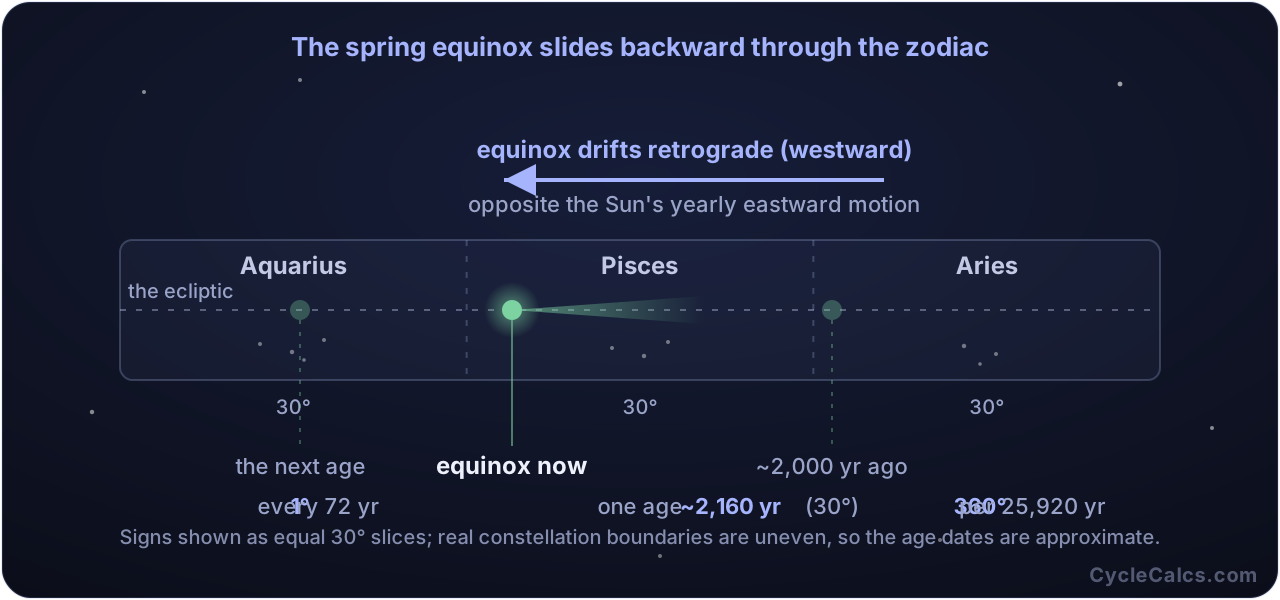
Astronomers call this moment's position among the stars the First Point of Aries: 0 degrees of ecliptic longitude and 0 hours of right ascension both begin there. The name is a fossil. Axial precession slides the equinox point westward against the stars about one degree every 71.6 years, a full circle in about 25,800 years; by the IAU boundaries it left the constellation Aries in 68 BCE, sits today in Pisces, and crosses into Aquarius around the year 2597. Tropical zodiac signs do not drift, because they are anchored to the equinox itself; the constellations behind the Sun do, which is exactly why signs and constellations no longer match. The full story is in our Precession lesson.
Aurora season
Geomagnetic activity is statistically higher around the equinoxes, a twice-yearly rhythm sitting in the records since Edward Sabine reported it in 1856. The leading explanation, the Russell-McPherron effect published in 1973, is geometric: around the equinoxes the orientation of Earth's tilted magnetic field relative to the interplanetary field makes the southward component that lets solar wind energy couple into the magnetosphere statistically more likely. It tilts the odds toward auroras; it guarantees nothing, and competing mechanisms contribute too. If you chase the lights, equinox weeks are the percentage play, especially near a solar maximum; our sunspot cycle lesson covers the other half of that equation.
A new year timed to the sky
Nowruz, the Persian New Year, is the major world holiday most directly tied to an astronomical instant: the Solar Hijri calendar begins its year at the actual computed moment of this equinox, reckoned for Iran's standard meridian at 52.5 degrees east. Its roots are Zoroastrian and more than two millennia deep, with spring festivities traditionally associated with the Achaemenid court at Persepolis. In Japan the equinox day is a national holiday, Shunbun no Hi, the center of the week-long Buddhist observance of Higan for honoring ancestors. And at Chichen Itza the setting Sun casts a chain of triangular shadows down El Castillo's northern balustrade to the serpent head at its base, the "descent of Kukulcan": spectacular, genuinely tied to the Sun's seasonal path, and honestly ambiguous, since surveys show the display runs for weeks around the equinox and archaeoastronomers still debate whether it was designed at all.
Frequently asked questions
Is day equal to night on the March equinox?
Not quite. Sunrise and sunset are timed from the Sun's upper edge, and refraction lifts the low Sun's image, so the equinox day runs several minutes longer than 12 hours at most latitudes. The near-equal date, the equilux, falls a few days earlier in the Northern Hemisphere; near the equator daylight beats 12 hours every day of the year.
Does the Sun really rise due east on the equinox?
Yes, for every observer outside the poles, on the days around the equinox and at no other time of year. The Sun sits on the celestial equator, which meets every horizon exactly at the east and west points. Mark the rise point against your local skyline and you have found true east for good.
Why is the March equinox called the First Point of Aries if the Sun is in Pisces?
Precession. The equinox point drifts westward against the stars about one degree every 71.6 years, so the name records where the point sat more than two thousand years ago; by the IAU boundaries it left Aries in 68 BCE. It lies in Pisces today and reaches Aquarius around 2597. Tropical zodiac measurements stay anchored to the equinox itself, which is why they no longer match the constellations.
Is the March equinox always on March 20?
Usually, in Universal Time, but not always: the UTC instant ranges from March 19 (next in 2044) to March 21 (last in 2007, next in 2102), and your time zone can shift the local date by a day. The drift comes from the 365.2422-day tropical year working against the leap-year cycle.
Are auroras really more likely near the equinoxes?
Statistically, yes: records back to the 1850s show geomagnetic activity peaking around March-April and September-October. The leading explanation, the Russell-McPherron effect, is a geometry that makes the solar wind couple to Earth's magnetic field more efficiently near the equinoxes. It improves the odds; it promises nothing on any given night.
Keep exploring: why the tilt makes the seasons, the tropical year our calendar tracks and the slow axial precession that carries the equinox westward against the stars over millennia, sunrise and sunset for any date, and The Sun with every equinox and solstice for two years.
The other three turning points
One tilted axis produces all four instants. Each page computes its own exact times and your local day length.
June Solstice
Falls June 20 to 22 (UTC), when summer begins astronomically in the Northern Hemisphere and winter in the Southern.
September Equinox
Falls September 21 to 24 (UTC), when autumn begins astronomically in the Northern Hemisphere and spring in the Southern.
December Solstice
Falls December 20 to 23 (UTC), when winter begins astronomically in the Northern Hemisphere and summer in the Southern.
Earth: the tilt behind all four
The 23.4 degree axial tilt that produces every equinox and solstice, with Earth's day, year, perihelion and aphelion.